
Intuitive Tarot Guide 2026|Experts Share 7 Must-Learn Techniques, Turning Beginners into Masters Through Self-Study!
免費 AI 八字排盤
10 個國際頂尖 AI 模型各自獨立批算再交叉覆核, 並由 1700 年起推演干支,找出與你年、月、日三柱完全相同的歷史真人對照。免費、無需留 Email。
Intuitive Tarot Interactive Guide
Daily Intuitive Draw
Click the card to draw
✨ Keywords
? Intuitive Guidance
Intuitive Tarot is not about rote memorization, but about "feeling" the card with your heart. The core concept is to trust your first impression and inner voice. Each card can have different meanings for each person at different times.
- Core: Your intuition > Book definitions.
- Getting Started: Draw one card daily, don't overthink it, just ask yourself: "What feeling does this card give me?"
- Practice: Connect your feelings to your question, keep a Tarot journal.
Reading cards is a process that combines imagery, symbols, and intuition. It's less about "interpreting" and more about "dialoguing" with the card.
- Observe the Imagery: Notice the colors, figures, actions, and scenes on the card. What particularly attracts you?
- Feel the Emotion: Does this card make you happy, worried, or hopeful? This emotion is the clue.
- Create a Story: Treat the card's scene as a story setting, with your question as the protagonist. How does the story develop?
- Mindset: Stay open, don't judge your first impression. All feelings are valid.
Choosing the right tools can make your divination experience smoother.
- Deck Selection: Choose a deck you "feel" connected to. The most important thing is that the art style is pleasing and resonates with you. The Rider-Waite Tarot is the most classic entry-level choice.
- Spreads: Beginners can start with a "Single Card" draw, or use the simple "Past-Present-Future" three-card spread. It doesn't need to be complex; clarity is key.
- Accessories: You can prepare a nice notebook for your Tarot journal, light some incense or candles to create a peaceful atmosphere, or use crystals to cleanse energy. These are all optional.
Good habits can make divination more accurate and constructive.
- Questioning Techniques: Try to ask "open-ended questions" (e.g., "How can I improve..."), avoid "closed-ended questions" (e.g., "Does he/she like me?"). Focus on things you can control.
- Common Mistakes: Repeating the same question, over-relying on the card's answer without taking action, ignoring your own intuition.
- So-called Taboos: The biggest taboo is an insincere attitude or wanting to test the Tarot. As long as you approach it with respect, there are no absolute taboos. Maintaining a calm mind is most important.
Tarot is not a crystal ball for predicting the future, but a mirror reflecting the inner self.
- Accuracy: The "accuracy" of Tarot lies in its ability to accurately reflect your current subconscious state and energy. The future can be changed.
- Psychological Perspective: The archetypes of Tarot cards are similar to the concept of the collective unconscious in Jungian psychology. They are tools that trigger thoughts and feelings deep within us.
- Self-Growth: View divination results as "guidance" or "suggestions," not "judgments." Think about what the card wants to remind you of, then apply this insight to your life. This is the greatest value Tarot brings.
Understanding Divination Results: Accuracy, Psychology, and Self-Growth
Intuitive Tarot for Beginners: Core Concepts and Getting Started Guide
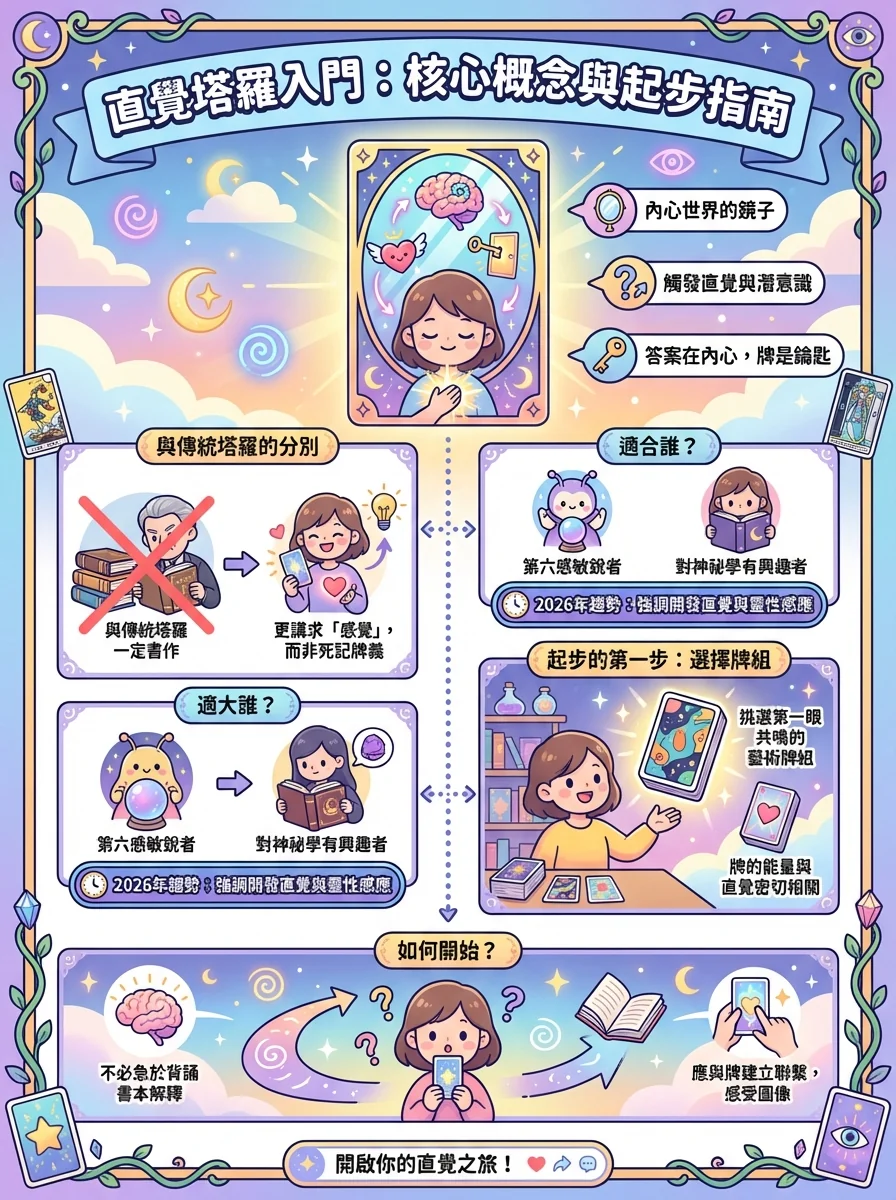
Hey, do you often feel your sixth sense is spot-on, or are you really interested in mystical things? If so, then "Intuitive Tarot" is perfect for you! Intuitive Tarot is very different from traditional fortune-telling. It doesn't give you a rigid, set-in-stone answer about what the future will definitely be. Instead, it's more like a mirror, reflecting your innermost world. Its core concept is simple: all the answers are already within you, and the Tarot cards are just a key to help you find them. The biggest difference from traditional Tarot is that it emphasizes "feeling" over rote memorization of card meanings. By 2026, this trend emphasizing the development of personal intuition and inspiration is getting stronger, so the way we learn Tarot needs to keep up!
Want to get started? The first step is to choose a deck that's right for you. It's recommended to pick a deck that you feel an immediate connection and resonance with at first sight, such as artistic decks with beautiful patterns and unique designs, because the energy of the deck is connected to your intuitive power. When you get a new deck, don't rush to memorize the explanations from the book. First, calm your mind and carefully observe the details of each card—its colors, composition, the expressions of the people on it, and even that "gut feeling" you get when you first see the card. All of these are signals from your intuition.
與其自己猜,不如讓 10 個 AI 一齊批:
• 今年運勢是好是壞?
• 財運事業運何時到?
• 哪個時期最適合投資?
So, how do you train your intuition? Many beginners have this question. The methods are actually quite straightforward:
- Daily One-Card Practice: Draw one card in the morning. Don't immediately look up the explanation in a book. First, feel what initial impression the card gives you. Does it feel warm or unsettling? Does it remind you of any stories? After thinking about it, then check the book to see the interpretation. It's best to prepare an "Intuition Journal" and immediately write down your associations (e.g., drawing "The High Priestess" reminds you of a very confidential document at work). Check back in the evening to see if it was accurate. The more you practice, the stronger your intuition will become.
- Combine with Energy Tools: You can try using a pendulum to double-check answers, or place some healing crystals nearby during a reading to enhance inspiration. However, note that some artificial crystals, while shiny and beautiful, may not have the same energetic potency as natural stones. You can also try using energy transformation devices to amplify your intuitive power.
- Start with Simple Spreads: Beginners shouldn't be too ambitious and start with overly complex spreads. Start by practicing with the most basic "Three-Card Spread" (e.g., Past/Present/Future). The key is to cultivate a sense of connection between you and your deck. You can try the "Three-Card Intuition Spread": the first card represents the current situation, the second is what your subconscious wants to tell you, and the third is the suggested action. When interpreting, you don't have to strictly follow the book. You can close your eyes to draw, touch the texture of the card with your hand, feel its energy, and then say the first word that flashes in your mind.
Additionally, the skill of "asking questions" is very important. Asking abstract questions like "Does he/she love me?" will only yield vague answers. You should make your questions more specific, such as: "What has changed in his/her attitude towards me recently?" or "What is the core lesson in our relationship?" Specific questions are more likely to trigger intuitive interpretation. Remember, try to avoid "yes/no" questions because Tarot excels at analyzing energy and trends, not predicting an absolute outcome. True intuition is often accompanied by strong physical reactions, such as a pang in your heart, warm palms, or a sudden "flash" of an image in your mind. If you're just guessing, your mind will constantly doubt itself. The core of Intuitive Tarot is that "how you see it" is far more important than "what the book says." Even if your interpretation is completely opposite to the book's, if your feeling is strong, you should trust yourself!
Understanding Divination Results: Accuracy, Psychology, and Self-Growth
The Art of Card Reading: Practical Skills and Mindset
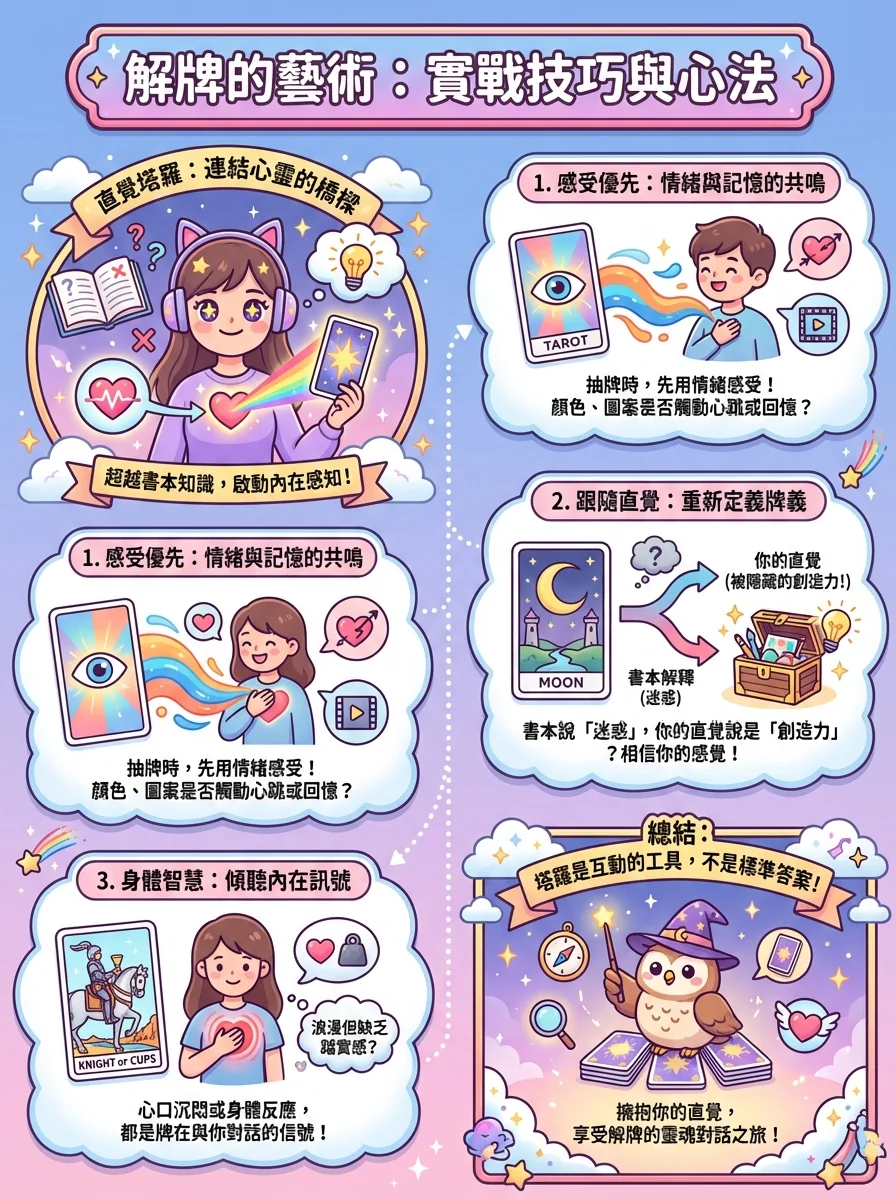
To become an excellent Tarot reader, relying solely on rote memorization of card meanings is far from enough. The true soul of it is mastering the skills and mindset of intuitive interpretation. Many beginners often get "stuck" during readings, their minds going blank. The problem is actually trusting the book too much and not trusting their own intuition! When you draw a card, don't immediately think about what the book says. Try to feel it with your emotions—maybe a certain color in the image makes your heart race, or a character's gaze evokes a memory. For example, if you draw "The Moon" card, the book says it represents confusion, but if your intuition tells you it actually represents "hidden creativity," then you should follow your own feeling. Tarot cards are interactive tools, not exam answer keys!
一個 AI 可能錯,10 個一齊講同一件事呢?
A senior expert once said, "Your body will tell you what the card means!" For example, when doing a love reading for someone and drawing "Knight of Cups," if your chest suddenly feels tight and heavy, it might hint that although the relationship looks sweet, it's actually not substantial enough. This sensitivity to the energy field can become sharper with practice. You can draw one card daily, without looking at the explanation, touch the card with your hand, close your eyes, take a deep breath, and note the first image or word that appears in your mind. Then compare it with the traditional meaning to see if there are commonalities. Keeping an "Intuition Journal" to record your physical reactions and associations during each reading will be very helpful for your progress.
Want to get more professional? Try these advanced techniques:
- Connect with Life Scenarios: Relate the positions in the spread to specific aspects of the question. For example, when using a complex spread for love, the card representing "the other person's thoughts" shouldn't just be a recitation of "King of Wands = passion," but should consider whether the other person has indeed been actively asking you out recently. This kind of self-awareness is the essence of intuitive reading.
- Observe the "Gaps" Between Cards: When interpreting an entire spread, the "empty spaces" between cards can also be clues—perhaps the direction the people's gazes are looking in two cards, or the gradient of colors. These are spiritual guidance often overlooked in traditional interpretation.
- Interactive Reading Method: When reading for others, you can ask them to choose a few energy stones on the spot (e.g., rose quartz for love questions). Based on the color and feel they choose, fine-tune your interpretation focus on the card's imagery. Finally, you can use a pendulum to confirm some key messages.
- Depth Control Method for Readings: This is key to improving accuracy and trust. Before the reading, sync with the client's emotions, for example, by having them touch your deck to connect the energy fields. The interpretation can be done in layers: first, the surface level, directly addressing their most pressing concern; then the subconscious level, perhaps adding auxiliary tools like oracle cards and observing their immediate reactions; finally, the soul level, combining other metaphysical systems (e.g., numerology) and spreads to guide the client to voice their deepest fears. For instance, a client may ask about love on the surface and draw "The Tower," but through deeper analysis, you might find the root issue is actually related to childhood family trauma. At this point, guide them slowly; don't reveal everything at once.
Remember, the biggest taboo in intuitive reading is "overthinking." It's not about wildly guessing, but adding your personal intuitive elements on the foundation of basic card meanings, and then verifying and adjusting with real-life situations. If you want to experience what a professional reading is like, or learn more about your overall fortune in 2026, why not try Master Xuan Shen's Free Divination Service. It's completely free, with results in as fast as 3 hours, and can help you forecast your 2026 annual fortune. It's a great experience!
Understanding Divination Results: Accuracy, Psychology, and Self-Growth
同一個盤,前人走過怎樣的路?
Divination Toolkit: Choosing Decks, Spreads, and Auxiliary Tools
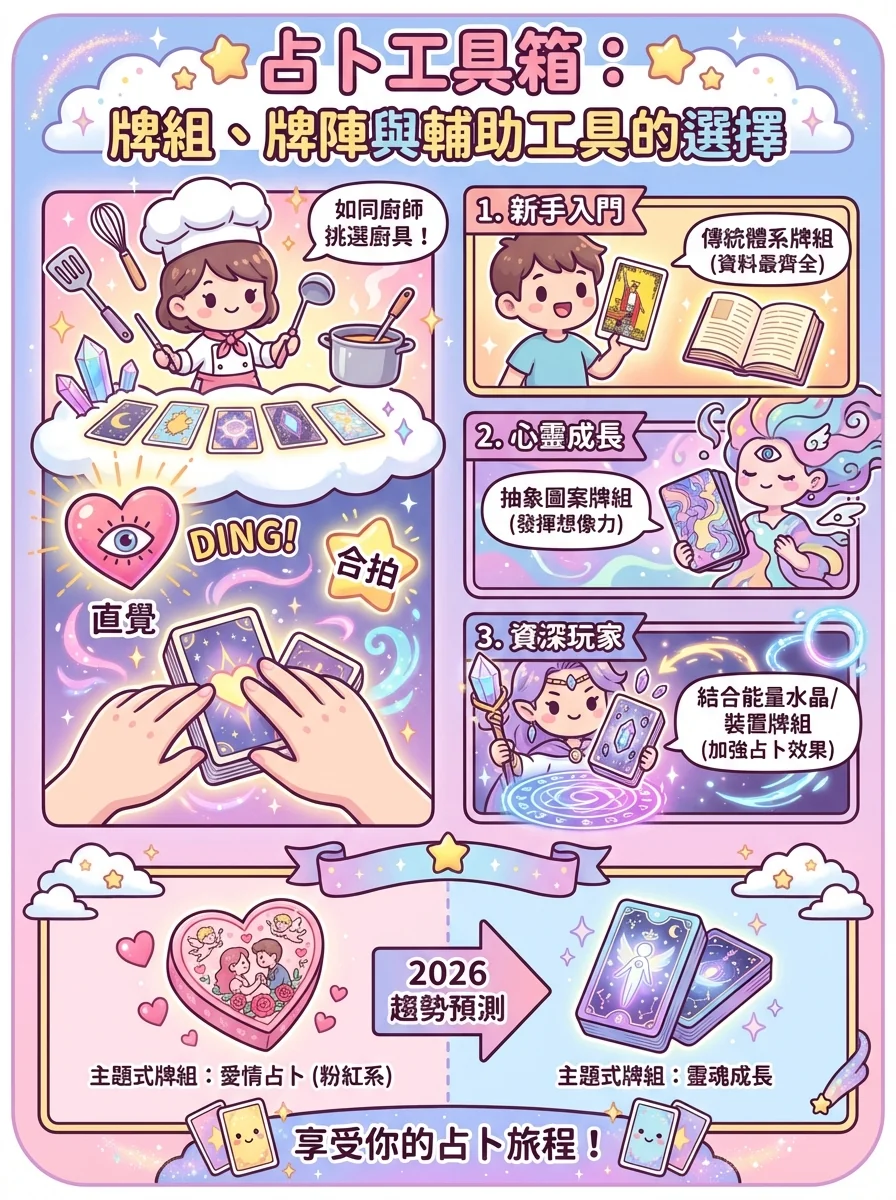
Choosing Tarot decks and spreads is like a chef choosing kitchen tools—it's a crucial part of the divination process. First and foremost, choosing a Tarot deck is all about "intuition." Especially for you practicing Intuitive Tarot, when you touch a deck, do you get that "aha" feeling? Pick up a deck and feel if its imagery and energy "click" with you. Between functionality and aesthetics, if a beginner wants to seriously learn card meanings, it's recommended to start with decks from traditional systems because their guidebooks are the most comprehensive, and tutorials are easy to find online. But if you purely want to use it for spiritual growth or intuition training, you can choose decks with more abstract imagery, giving yourself more space for imagination.
Seasoned players might pursue more unique decks, such as those designed with energy crystals or decks that can be used with energy transformation devices to enhance readings. By 2026, a clear trend is "themed decks," such as pink-themed Tarot decks specializing in love readings, or Zen cards designed for soul growth. These decks often come with theme-specific guides, making them suitable for those wanting to delve deeply into a specific area.
The choice of spreads is equally crucial. They are like your "toolbox" and should be decided based on the type of question and your experience level:
- Beginner Recommendation: Start with the most basic "Single Card Draw" or "Three-Card Spread" (e.g., Past-Present-Future). These spreads are simple and direct, great for quick answers or daily practice, helping you get familiar with linking card meanings into a complete story.
- Love Divination: You can choose the "Love Cross Spread" or "Mirror of Relationship Spread." For example, the five cards in the "Love Cross Spread" can represent "Your Mindset," "Their Mindset," "Relationship Obstacles," "External Influences," and "Future Development," giving a clear overview of the entire relationship.
- Career and Decision-Making: When facing complex workplace issues or needing to make decisions, classic ten-card spreads like the "Celtic Cross Spread" are excellent choices for a comprehensive analysis of the problem's core, internal/external influences, and final outcome. If you're just hesitating between a few choices, the "Three Options Spread" is more suitable.
- Spiritual Growth: Friends interested in energy healing can try using the "Tree of Life Spread" or "Chakra Balancing Spread," which aids energy flow and self-exploration.
Advanced players can challenge themselves with "Intuitive Spreads," meaning not following traditional fixed positions but placing cards purely based on feel. This method requires strong intuitive power, but the interpretations can often be surprisingly insightful. When interpreting large spreads, pay special attention to the "energy flow" between cards. For example, if many Wand cards appear, it might suggest you need to be more proactive; if there are mostly Cups, it reminds you to handle interpersonal relationships carefully. Finally, using a dedicated Tarot cloth not only protects your deck but also helps you focus energy. Remember, spreads are rigid, but intuition is alive. The most important thing is to combine the two to find clear guidance.
Understanding Divination Results: Accuracy, Psychology, and Self-Growth
Best Practices: Divination Taboos, Common Mistakes, and Questioning Techniques
Playing Tarot isn't just about randomly drawing a few cards. Whether you're a beginner or a seasoned practitioner, you should follow some basic taboos and best practices to ensure accurate readings and protect your energetic health. Tarot cards are tools for connecting with the subconscious; we must respect them.
Preparation and Mindset Before a Reading:
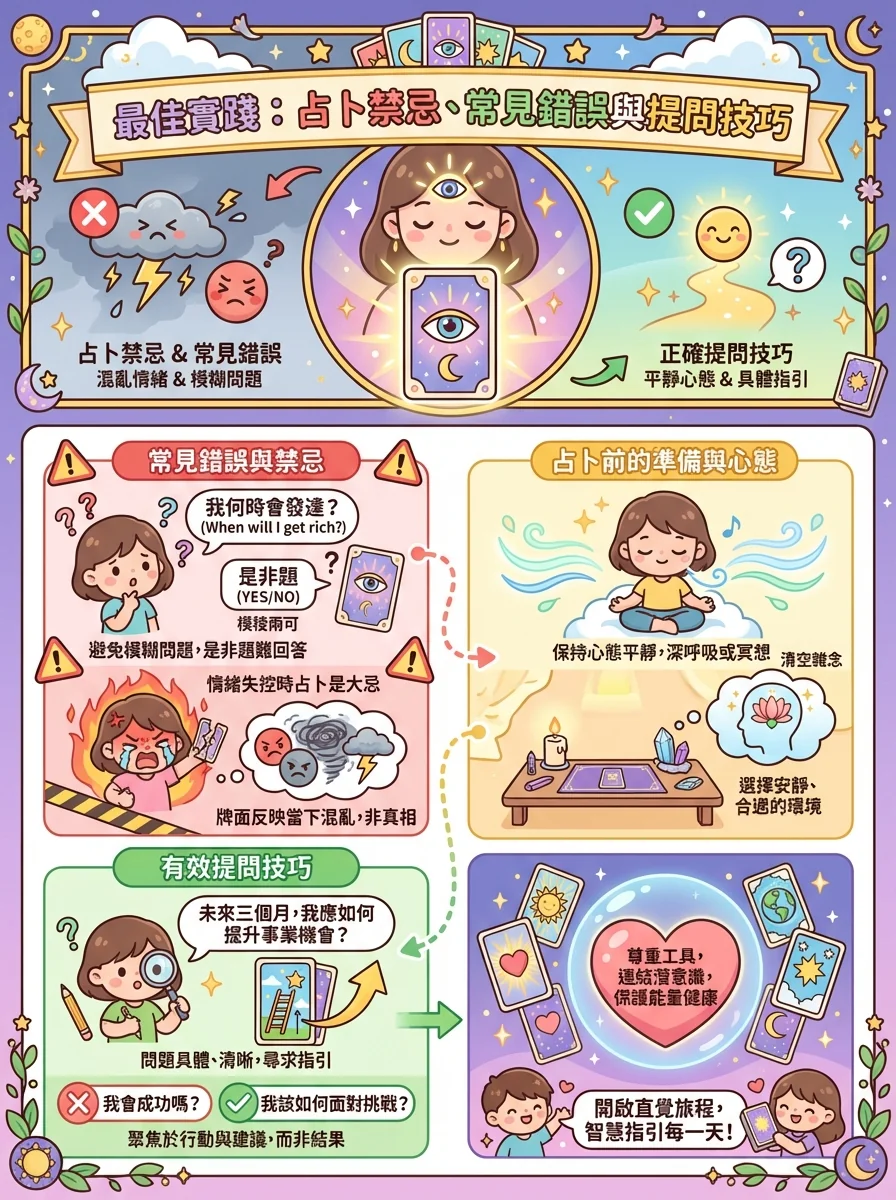
- Clarify the Question: Vague questions only yield ambiguous answers. Instead of asking "When will I get rich?", be more specific: "In the next three months, how can I improve my career opportunities?" Clear, specific questions help the reader and the Tarot cards better connect with your energy. Remember, avoid asking Tarot "yes/no" questions it's not good at answering.
- Maintain a Calm Mindset: Before a reading, it's best to take deep breaths or meditate to clear your mind. Doing a reading during extreme emotional turmoil (e.g., very angry or sad) is a major taboo because the cards likely reflect your current chaotic emotions, not the truth of the situation.
- Choose a Good Environment: Choose a quiet, softly lit place where you won't be disturbed. Opening cards in a noisy or chaotic environment can interfere with the energy field and affect the results.
Taboos During the Reading Process:
- Avoid Repeated Readings: Constantly asking the same question in a short period will make the messages chaotic and contradictory, and also reflects inner anxiety and distrust. It's recommended to wait at least a few days after each reading, or until the situation has changed significantly, before asking again, giving yourself time to digest the messages. Reading too frequently can cause energetic confusion, making it unclear which answer to trust.
- Avoid Using Others' Decks: Especially second-hand decks, which may retain the previous owner's energy. If it's not your own deck, it's best to perform an energy cleansing before use.
- Respect Professional Boundaries: For ethical and legal reasons, Tarot readings should not address sensitive questions regarding life safety, major illness diagnosis, legal disputes, or financial investment advice. Please be sure to consult professionals in the relevant fields for such matters.
Common Mistakes Beginners Make:
- Over-reliance on Books: Rote memorization of card meanings while ignoring intuition and details in the card imagery limits the depth of your interpretation.
- Confirmation Bias: Only listening to answers you want to hear, and repeatedly drawing cards until you get a satisfactory one. This is deceiving yourself and goes against Tarot's nature of seeking truth.
- Ignoring the Overall Energy of the Spread: For example, if many Court cards appear in a spread, it might hint that the key to the problem lies in interpersonal relationships, not just the event itself.
- Avoid Over-dependence: Tarot is a tool for guidance and reflection, not an absolute answer to fate. Even if you draw seemingly negative cards like "Death" or "The Tower," don't be afraid. They often represent the end of a phase or a necessary breakthrough. The final decision-making power always lies in your hands. Want to know what to watch out for in 2026? Consider using Master Xuan Shen's Free Divination Service. Results in as fast as 3 hours, helping you get a free forecast of your 2026 annual fortune. It's free, fast, and great for reference!
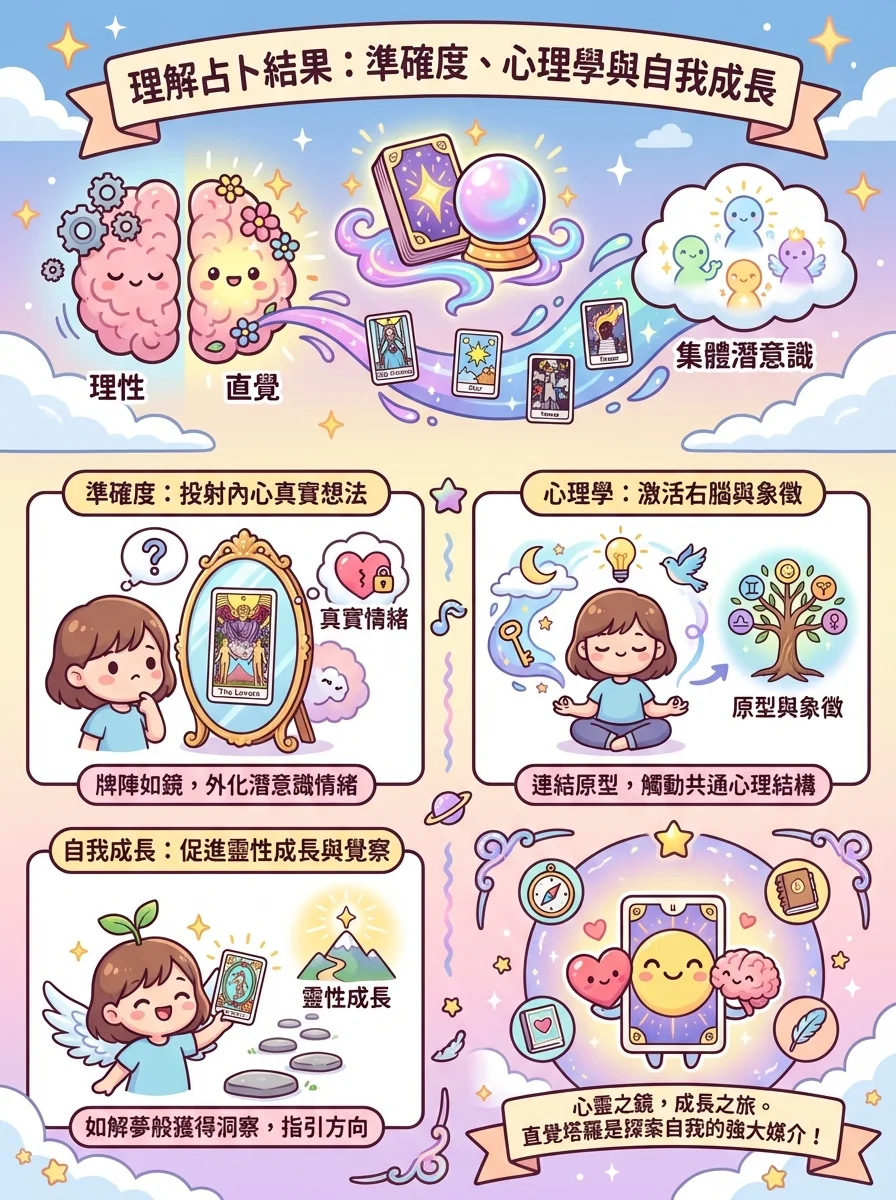
Understanding Divination Results: Accuracy, Psychology, and Self-Growth
即時四柱五行排盤 + 命格角色卡,由十神實算,配以過萬真實命例大數據交叉分析。
Understanding Divination Results: Accuracy, Psychology, and Self-Growth
Tarot cards are not just divination tools; they are a powerful medium for exploring the subconscious and promoting spiritual growth. Their operating principle is deeply related to modern psychology. For example, psychologist Jung's theories of the "collective unconscious" and "archetypes" can explain why Tarot images (like The Tower, The Star, The High Priestess) can transcend cultures and touch upon universal human psychological structures. When we perform intuitive Tarot readings, we are actually activating the right brain's creativity and ability to process symbols, similar to psychologists' techniques for dream interpretation.
The Tarot reading process is like a mirror. Through the arrangement of cards, it externalizes and projects our innermost thoughts and emotions, which may be suppressed by rational thinking. For example, drawing "The High Priestess" in a love reading might reflect that deep down, you've already sensed your partner is hiding something, but you're afraid to face it. This process is similar to "free association" or "sandplay therapy" in psychotherapy, using symbols to explore the inner world, thereby enhancing "self-awareness."
So, how should we view the accuracy of Tarot predictions? First, it's important to understand that Tarot reflects not a predetermined future, but the "current flow of energy" and the "trends" that might develop based on this energy. The future can change due to human actions and thoughts. Its accuracy is influenced by many factors:
- The State of the Reader and Querent: The reader's intuition, experience, and state of mind, as well as the querent's emotions and focus, directly affect the energy connection and clarity of the interpretation.
- Clarity of the Question: A clear, specific question is more likely to yield a guiding answer than a vague, general one.
- Interactivity of the Reading: Professional Tarot reading is a two-way communication. The reader guides the querent to reflect, linking card meanings with their personal life experiences, rather than unilaterally "declaring" fate.
- Open-mindedness Towards Results: Treat reading results as a tool for reference and reflection, not absolute truth. If the result isn't what you wanted, don't feel hopeless. Instead, think about how to avoid certain situations. Tarot's role is to prepare for the future, providing guidance and insight.
In summary, instead of obsessing over "accuracy," ask yourself: "What inspiration does this reading offer for my spiritual growth?" The true value of Tarot lies in its role as a tool for developing intuition and self-exploration. Through practice, you will gradually build your own unique interpretation database and discover that Tarot can not only help you see external situations clearly but also guide you to deeply understand your inner world, achieving soul growth. If you also want to understand yourself more deeply through divination, why not try Master Xuan Shen's Free Divination Service. They provide results in as fast as 3 hours and can help you get a free forecast of your 2026 annual fortune. It's a great start for self-exploration!
What is Intuitive Tarot? How is it different from traditional Tarot?
Intuitive Tarot places more emphasis on the reader's personal intuition and connection with the card imagery, rather than rote memorization of traditional meanings. It views Tarot as a mirror, reflecting your inner subconscious and wisdom, helping you find direction. In comparison, traditional Tarot tends to more strictly adhere to fixed meaning systems and focuses more on the function of divination and prediction.
- Personalized Interpretation: Emphasizes the real-time connection between the reader's and querent's energy fields, making interpretations more personal.
- Tool, Not Prophecy: Views Tarot as a tool for self-exploration and inspiration, not an absolute prophecy of fate.
- Greater Flexibility: Not limited to a single meaning; can combine imagery and feelings from different cards for a comprehensive interpretation.
How does Intuitive Tarot work? Do you need supernatural powers to use it?
Intuitive Tarot does not require any "supernatural powers"; it is a practice of developing and trusting your own intuition. The reader uses the cards as a medium to connect with your subconscious energy, transforming the images, symbols, and colors on the cards into meaningful messages. This process is more like a deep spiritual conversation, helping you understand your true inner thoughts.
- Energy Resonance: Through focus, your question and energy resonate with the cards, drawing the corresponding ones.
- Subconscious Projection: The card images trigger thoughts and feelings deep within you; the reader helps interpret these projections.
- Intuition Development: Everyone has intuition; Intuitive Tarot is simply a tool to make it tangible and systematic.
Is Intuitive Tarot accurate? Will the results definitely happen?
The "accuracy" of Intuitive Tarot lies in its ability to accurately reflect your current inner state and potential future possibilities, not in being an ironclad prophecy. The future is created by your choices and actions. Tarot provides guidance and insight, helping you see the situation clearly so you can make better decisions and take control of your life.
- Reflects Current Energy: Reading results show the most likely trends based on your current mindset and actions.
- Provides Guidance: The purpose is to offer suggestions and inspiration, not to pronounce your fate.
- Free Will: You always have the power to change the future. Reading results are a reference, not the final destination.
Can I self-study Intuitive Tarot? What tips can I follow?
Absolutely! Self-studying Intuitive Tarot is a wonderful journey of self-exploration. Instead of memorizing book meanings, try drawing one card daily, quietly feeling what sensations the image brings you, and then record your insights. Slowly build a unique connection between you and your cards. This process itself is healing.
- Card of the Day: Draw one card daily without a specific question, simply feel the message it wants to bring you that day.
- Keep a Tarot Journal: Record your intuitive feelings, associations, and real-life correspondences for each card.
- Trust Your First Feeling: When interpreting, the first thought that pops into your head is often the most important. Don't overanalyze or doubt yourself.
Looking for a good Intuitive Tarot reader in 2026, what should I pay attention to?
In 2026, with abundant information and many choices, finding a Tarot reader that suits you is all about the "right feel." You can first check out their style and reviews on well-known social platforms or spiritual service websites. Many professional readers provide introductions so you can understand their philosophy and expertise, helping you make a choice.
- Style and Philosophy: Understand if they focus on psychological analysis, spiritual guidance, or practical advice. Choose one that matches your expectations.
- Client Reviews: Refer to past clients' genuine feedback, but remain objective. Your own judgment is most important.
- Clear Communication: A good reader will clearly explain their service process and fees and be able to create a safe, pressure-free communication environment.
How much does an Intuitive Tarot reading cost nowadays (2026)? Why is there such a wide price range?
As of 2026, the price range for Intuitive Tarot readings in the market is quite broad, ranging from a few hundred to several thousand Hong Kong dollars per session. The price difference mainly depends on the reader's experience, reputation, session length, and the complexity of the question. Some senior practitioners may offer more in-depth, integrated spiritual counseling services, which naturally cost more.
- Experience and Qualifications: Readers with many years of experience and a rich background typically charge higher fees.
- Session Length and Depth: A quick 15-minute single-question session is naturally priced differently from an in-depth one-hour annual fortune analysis.
- Service Format: Online text, voice call, or in-person readings have different costs, which affects the price.
Are there any dangers or risks of "inviting negative entities" when practicing Intuitive Tarot?
As long as you maintain a positive and respectful attitude, Intuitive Tarot is a very safe tool for self-exploration. It inherently does not possess any evil or dangerous energy. The so-called "inviting negative entities" often stems from personal fears and projections. View it as a spiritual companion, not a tool for spirit communication, and there will be no issues.
- Maintain Positive Intent: Before a reading, you can do a simple meditation, setting the intention to gain clarity and guidance.
- Create Personal Protection: If you are sensitive, you can visualize a light shield protecting you, blocking out unnecessary interference.
- Believe in Yourself: Remember, you are the master of your own energy. Tarot cards are merely tools to assist you.
I've booked an Intuitive Tarot reading. What do I need to prepare beforehand?
To make the reading process smoother and more fruitful, preparation is very important. You can first calm your mind and think clearly about the question you most want to ask, making it specific. On the day of the reading, maintain a relaxed and open mindset, don't have any preconceived notions, and be ready to receive the messages the cards want to bring you.
- Prepare Clear Questions: Transform vague worries (e.g., "My work isn't going well") into specific questions (e.g., "How can I improve my relationship with my boss?").
- Maintain an Open Mind: Be prepared to listen to any possibilities, even if the answer might not be what you most want to hear.
- Choose a Quiet Environment: If it's an online reading, ensure you are in a space where you won't be disturbed, allowing you to focus on the conversation.
There are so many Tarot decks on the market. How do I choose one suitable for Intuitive Tarot?
Choosing a Tarot deck is like making friends; the most important thing is "love at first sight." It's recommended not to just rely on others' recommendations. You can look online at the imagery styles of different decks and see which one most moves you and resonates with you. A deck you love will motivate you to interact and learn with it more, thereby deepening your intuitive power.
- Imagery Style: Choose an art style you find pleasing and that stimulates your imagination and intuition, such as realistic, cartoonish, or abstract.
- Theme and System: Some decks revolve around specific themes (e.g., cats, mythology). You can choose an area you're interested in.
- Personal Feel: If possible, visit a physical store to feel the texture and size of different decks in person. Choose one that feels most comfortable in your hands.