
2026 Chinese Almanac|Top 5 Date Selection Tips, Master Wedding & Moving Day Picking in One Article!
免費 AI 八字排盤
10 個國際頂尖 AI 模型各自獨立批算再交叉覆核, 並由 1700 年起推演干支,找出與你年、月、日三柱完全相同的歷史真人對照。免費、無需留 Email。
Personal Fortune Prediction and Feng Shui Layout Guide
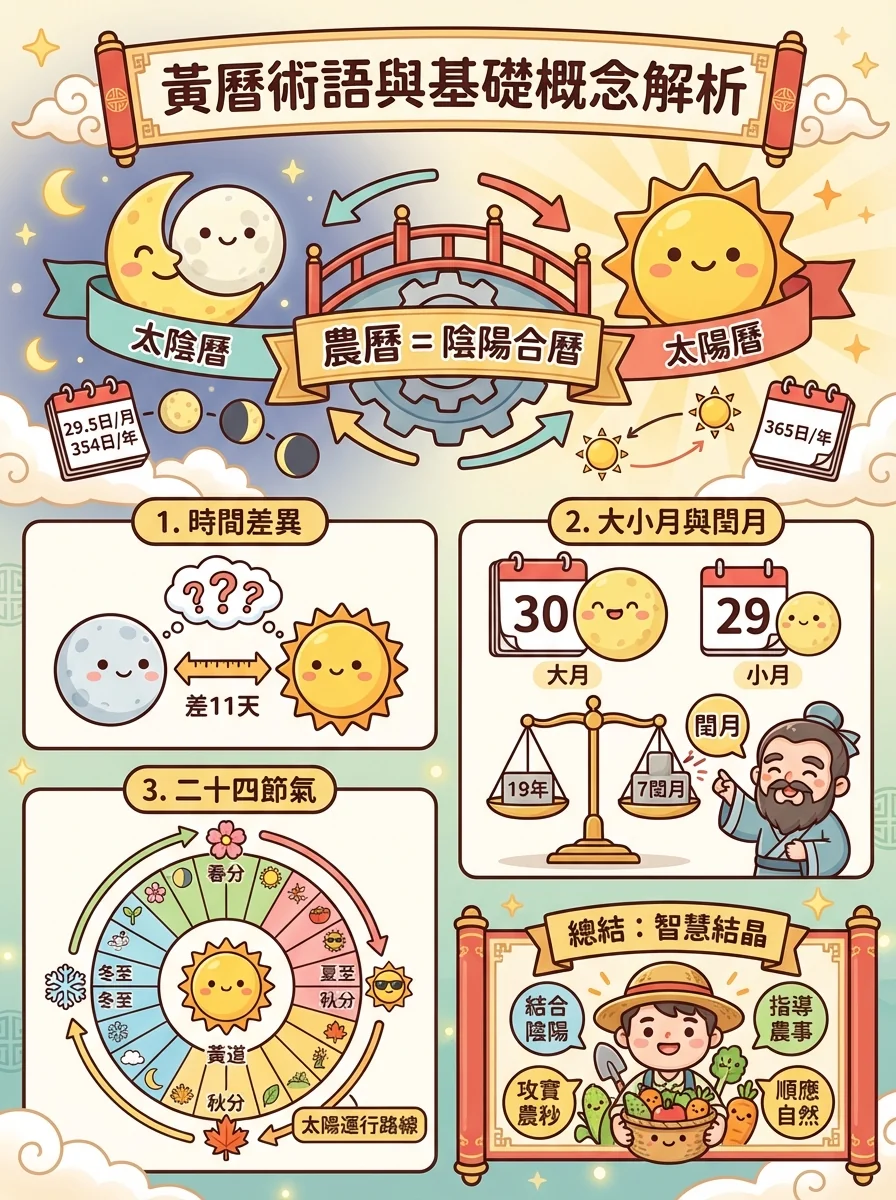
Explanation of Almanac Terms and Basic Concepts
Many people think "Lunar Calendar" is the same as "Lunisolar Calendar", but that's not entirely accurate! The traditional calendar we use is actually a "Lunisolar Calendar" that combines the patterns of the moon (lunar calendar) and the sun (solar calendar). Ancient people were very clever, observing both the moon's phases and the sun's path. The so-called "Lunar Calendar" calculates months based on the moon's cycle from new to full and back to new, which is about 29.5 days. Twelve of these cycles total about 354 days, which is about 11 days shorter than a solar year. To fix this discrepancy, ancient people devised a system with 30-day "big months" and 29-day "small months", and added "leap months", typically adding 7 leap months within a 19-year cycle, making the calendar much more accurate. As for the "Solar Calendar", it observes the sun's path (i.e., the ecliptic), dividing a year into twelve solar months, each further divided into two "solar terms", totaling the well-known "24 Solar Terms". The advantage of the solar calendar is that the months align closely with seasonal weather. Simply put, the solar calendar follows the sun, the lunar calendar follows the moon, and the Chinese Almanac we commonly use is the combined wisdom of both.
Speaking of the Chinese Almanac, you might have heard of the "Perpetual Calendar". It's not literally usable for ten thousand years; that's just an exaggeration meaning this calendar book can be used for many years without needing much adjustment, usually containing data for over a hundred years. When people search for a perpetual calendar online, they are mostly looking for information from the Chinese Almanac, such as daily auspicious and inauspicious activities, zodiac clashes, and auspicious hours. Ancient fortune-telling masters would add their interpretations to the official calendar to "determine fortune and misfortune, clarify what to pursue and avoid"; this was called "Tong Shu" in folk culture. However, because "Shu" (book) sounds like "Shu" (to lose), it was later renamed "Tong Sheng". Authentic Tong Sheng content is very professional and complex, mainly for use by masters at altars, temples, or fortune-telling shops. The "Chinese Almanac" we usually buy can be considered a "simplified version" of the Tong Sheng, for reference by ordinary citizens.
與其自己猜,不如讓 10 個 AI 一齊批:
• 今年運勢是好是壞?
• 財運事業運何時到?
• 哪個時期最適合投資?
As for the "Heavenly Stems and Earthly Branches Calendar" (Ganzhi), its history is even longer, with evidence of its use for record-keeping dating back to the Shang Dynasty. The ten Heavenly Stems (Jia, Yi, Bing, Ding, Wu, Ji, Geng, Xin, Ren, Gui) and twelve Earthly Branches (Zi, Chou, Yin, Mao, Chen, Si, Wu, Wei, Shen, You, Xu, Hai) combine in sequence to form the "Sixty Jiazi Cycle". Starting from the Han Dynasty, a day was divided into twelve two-hour periods, represented by the Earthly Branches, such as Zi hour, Chou hour, etc., and later also used to record months and years.
The terminology in the Chinese Almanac isn't written randomly; there's a set of logic behind it related to fortune-telling, the Five Elements, and the 24 Solar Terms. For example, "Auspicious Hours" are calculated based on the day's Heavenly Stems, Earthly Branches, and the balance of the Five Elements. For instance, **2026 is the Year of Yi Si**, with strong Fire element energy. When choosing a date, one must be smart and try to avoid the "Wu hour" (11 am to 1 pm), because Wu hour belongs to Fire, and adding Fire to Fire can easily lead to trouble, especially for important occasions like opening a business or choosing a wedding date, one must be careful. Another example is "Peng Zu's Hundred Taboos", which is like an ancient memo of taboos, reminding you that "On Jia days, do not open warehouses; on Xu days, do not eat dog meat" – meaning on Jia days, don't open warehouses to take things out (said to lead to financial loss), and on Xu days, don't eat dog meat (traditionally believed to cause conflict). Although people today may not follow these strictly, traditional masters still refer to them.
Then there's the "Four Pillars of Destiny" (Ba Zi), which is calculated based on the year, month, day, and hour of your birth using the Heavenly Stems and Earthly Branches calendar, resulting in eight characters (four pillars), combined with the Five Elements (Metal, Wood, Water, Fire, Earth) to analyze your personality and fortune. For example, if your Ba Zi calculation shows a "lack of Fire", a master might suggest adding a character with a "fire" radical when choosing a name, or wearing red accessories to compensate. The daily "Auspicious and Inauspicious" activities are determined by synthesizing the Five Elements, auspicious and inauspicious deities, and traditional customs. Therefore, a day "suitable for worship" might not be suitable for signing contracts; judgment should be based on what you plan to do. At this point, you might be curious about your own Ba Zi and Five Elements. Actually, it's very convenient nowadays; you can try Master Xuan Shen's Free Divination Service. They can help you analyze your **2026 annual fortune**, with results available in as fast as 3 hours, and it's completely free!
Personal Fortune Prediction and Feng Shui Layout Guide
一個 AI 可能錯,10 個一齊講同一件事呢?
Daily Almanac Query: Auspicious/Inauspicious, Clashes, and Hourly Fortune
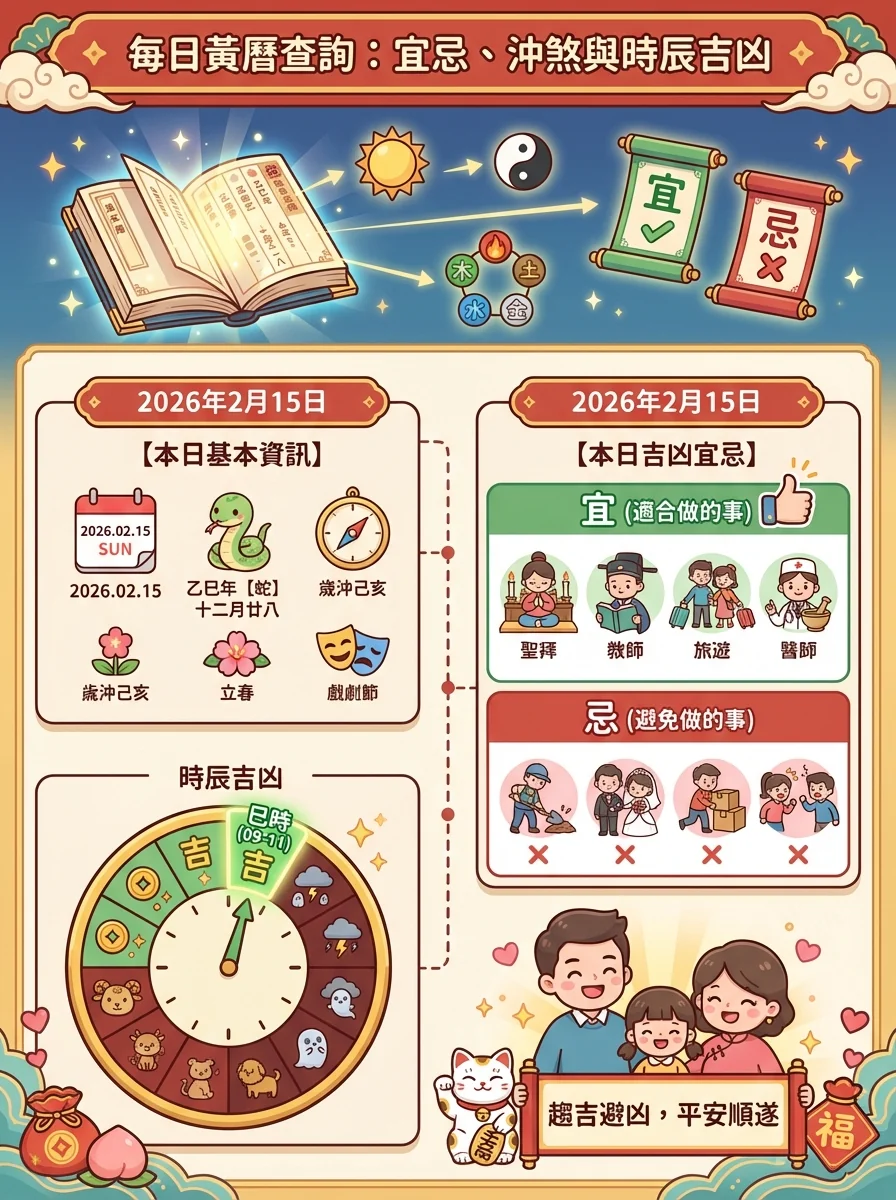
Alright, just talking theory might be a bit boring. Let's be more practical and use **February 15, 2026** as an example to teach everyone how to read the information on the Chinese Almanac!
【Basic Information for This Day】
- Gregorian Date: February 15, 2026, Sunday
- Lunar Date: Year of Yi Si [Snake], 12th Month, 28th Day
- Year Designation: Year of Yi Si, Zodiac Snake, Year's Guardian Deity is Wu Zhu Xing Jun, Day's Clash with Year Branch: Ji Hai
- Month Designation: First Month of Spring, First Lunar Month, Geng Yin, Month's Inauspicious Direction: North, Month's General: Zi, Month's Guardian Deity is Wu Huan Xing Jun, Month's Clash: Jia Shen
- Solar Term: Still within the "Beginning of Spring" solar term period (from February 4, 2026 to February 17)
- Important Festival: Drama Festival
【Auspicious/Inauspicious Activities for This Day】
- Auspicious (Suitable Activities): Seeking medical treatment, treating illness, demolishing houses, tearing down walls (Simply put, this day is a "Break Day", perfect for destructive activities, not much else is suitable)
- Inauspicious (Activities to Avoid): Opening a business, getting married (For these major life events, choosing this day would be a big mistake)
- Clash: Clashes with Tiger (Jia Yin, especially friends aged 53 who are Tigers need to be extra careful)
- Inauspicious Direction: South (Meaning negative energy is in the south, avoid ground-breaking or renovations in that direction)
- Peng Zu's Hundred Taboos: On Geng days, do not engage in weaving or setting up looms; during Shen hours, do not install beds, lest evil spirits enter the room. (On Geng days, avoid activities related to textile machinery; during Shen hours, avoid installing beds to prevent attracting negative entities.)
- Fetal God Location: Mortar, Millstone, Stove, Outside Southeast (Meaning today the Fetal God is near the mortar, millstone, stove, and the southeast area outside the home. If there is a pregnant woman at home, avoid disturbing these areas.)
【Deity and Inauspicious Directions for This Day】
- Auspicious Deities (Beneficial Star Deities): Tian De (Heavenly Virtue), Yue De (Monthly Virtue), Mu Cang (Mother's Storehouse), Yang De (Sun Virtue), Wu Fu (Five Riches), Fu Sheng (Birth of Fortune), Chu Shen (Removing Deities), Si Ming (Controller of Fate), Ming Fei (Crowing Dog), Wang Ri (Prosperous Day), Da Ming (Great Brightness), Bu Shou Zhong Ming Fei (Crowing Dog Not Guarding Grave), Da Tou Xiu Tian Yue (Great Repair Heavenly Mountain), Yi Ma (Travelling Horse), Jie Shen (Relieving Deity), Pu Hu (Universal Protection) (The more auspicious deities, the better the day's foundation)
- Inauspicious Deities (Malevolent Deities to Avoid): You Huo (Wandering Misfortune), Wu Li (Five Separations), Ba Zhuan (Eight Specialties), Zheng Si Fei Po Qun (True Four Ruins Breaking Group), Gu Lun (Drum Wheel), Zhong Ri (Double Day), Zhu Que Zhong Yue Po (Vermilion Bird Mid-Month Break), Tian Lao (Heavenly Prison), Si Fei (Four Ruins), Da Hao (Great Waste) (Wow! Seeing so many malevolent stars indicates this day is 90% not a good day)
- Joy God Direction (For Romance & Peach Blossom Luck): Northwest
- Fortune God Direction (For Blessings & Safety): Southwest
- Wealth God Direction (For Wealth Luck): Due East
【Hourly Fortune for the Day】
A day has twelve two-hour periods, each with different fortune levels; choose the right time for different activities.
- Zi Hour (23:00-00:59) - Clashes with Horse / Inauspicious Direction: South / Auspicious: This hour is quite good, suitable for praying for blessings, marriage, installing beds, moving house, worship, seeking wealth, opening a business.
- Chou Hour (01:00-02:59) - Clashes with Goat / Inauspicious Direction: East / Auspicious: Also an auspicious hour, suitable for opening a business, moving into a new home, installing beds, marriage, praying for offspring.
- Yin Hour (03:00-04:59) - Clashes with Monkey / Inauspicious Direction: North / Inauspicious: A very unlucky hour, nothing goes well, best to stay quietly in bed and not move around.
- Mao Hour (05:00-06:59) - Clashes with Rooster / Inauspicious Direction: West / Auspicious: Although auspicious, it's marked with the day's value 【Vermilion Bird】, meaning there might be disputes or gossip. If handling affairs, it's best to use specific methods to resolve it first.
- Chen Hour (07:00-08:59) - Clashes with Dog / Inauspicious Direction: South / Auspicious: This hour has strong fortune, suitable for marriage, moving into a new home, moving house, traveling, seeking wealth, opening a business – most things are suitable.
- Si Hour (09:00-10:59) - Clashes with Pig / Inauspicious Direction: East / Auspicious: Another auspicious hour, suitable for worship, renovation, marriage, opening a business, moving house.
- Wu Hour (11:00-12:59) - Clashes with Rat / Inauspicious Direction: North / Auspicious: Although auspicious, it coincides with 【White Tiger】, representing risk of bloodshed or injury. Even if marriage, opening a business, or burial is listed as suitable, it's best to perform a resolution first, to be safer.
- Wei Hour (13:00-14:59) - Clashes with Ox / Inauspicious Direction: West / Auspicious: Auspicious hour, suitable for renovation, moving house, installing beds, opening a business, marriage.
- Shen Hour (15:00-16:59) - Clashes with Tiger / Inauspicious Direction: South / Auspicious: This time period is suitable for seeking wealth, meeting noble people, marriage, opening a business, but avoid starting a new job, moving house, or traveling.
- You Hour (17:00-18:59) - Clashes with Rabbit / Inauspicious Direction: East / Auspicious: Auspicious hour near dusk, suitable for praying for offspring, marriage, moving house, opening a business, transactions.
- Xu Hour (19:00-20:59) - Clashes with Dragon / Inauspicious Direction: North / Auspicious: Dinner time is also an auspicious hour, suitable for praying for blessings, praying for offspring, marriage, seeking wealth, opening a business, installing beds.
- Hai Hour (21:00-22:59) - Clashes with Snake / Inauspicious Direction: West / Auspicious: Auspicious hour before sleep. If there are renovation or burial matters, they can be handled at this time, but avoid long-distance travel.
Personal Fortune Prediction and Feng Shui Layout Guide
Complete Guide to Date Selection for Life: Wedding, Business Opening, Moving House
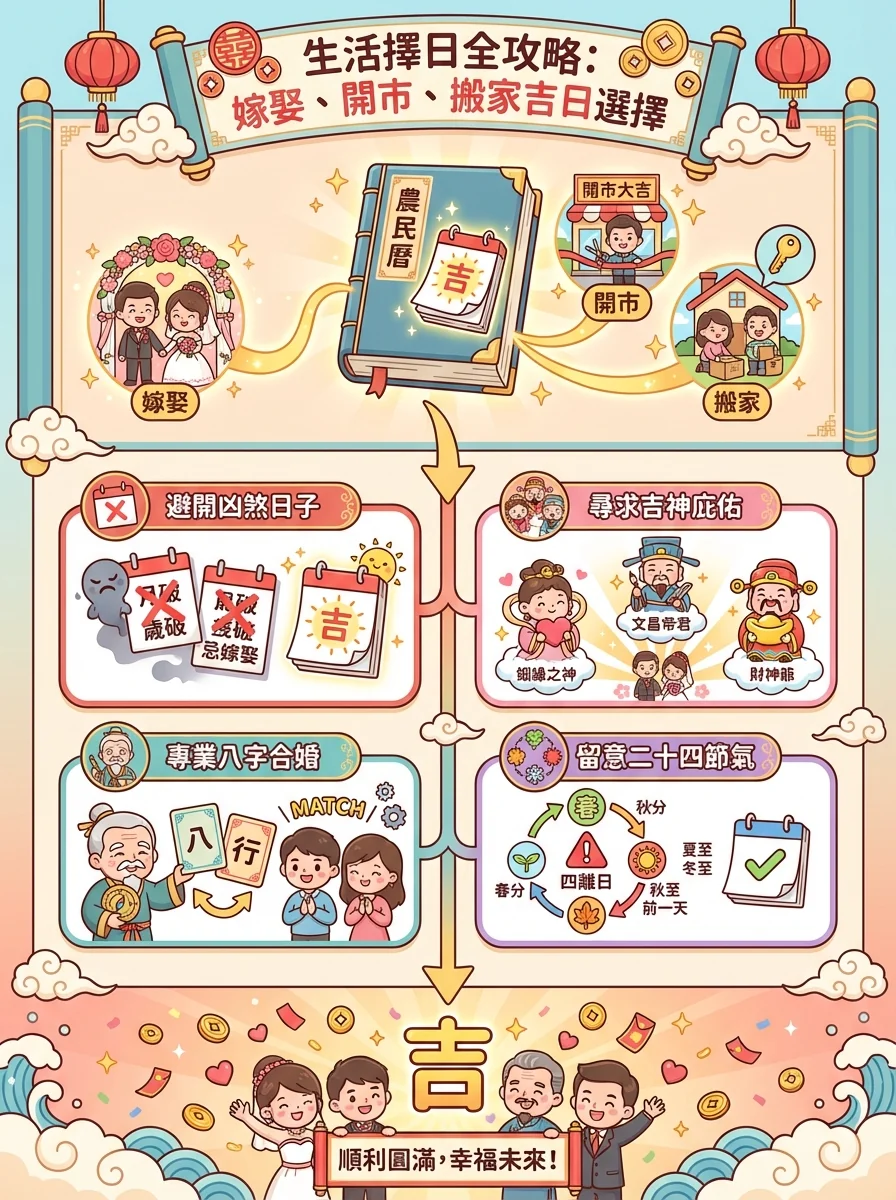
"Date Selection" can be said to be one of the core functions of the Chinese Almanac. For major life events like marriage, opening a business, or moving house, choosing the right date can make things go smoothly. Here are some practical tips for you.
【Choosing an Auspicious Wedding Date】
Marriage is a major life event; how can you be casual about choosing the date! The first step is to avoid unlucky days, such as those marked "Month Break", "Year Break" on the almanac, or days where Peng Zu's Hundred Taboos clearly state "Avoid marriage"; blacklist all of them first. Second, it's best to choose days with "Auspicious Deities" watching over, such as days blessed by the God of Marriage, the God of Literature (Wenchang Dijun), or the God of Wealth, which are beneficial for the marriage and future career. Professional masters will also choose an auspicious hour for the ceremony based on the compatibility of the couple's Ba Zi and Five Elements. Additionally, pay attention to the 24 Solar Terms; definitely avoid the "Four Departure Days" (the day before the Spring Equinox, Autumn Equinox, Summer Solstice, and Winter Solstice), traditionally believed to have very unstable energy fields. Also, check if the day's Heavenly Stems and Earthly Branches clash with the couple's zodiac signs. For example, a person born in the Year of the Monkey should not get married on a Tiger day. Suppose you plan to tie the knot in October 2026. You can first use a perpetual calendar to filter out the 7th lunar month (Ghost Month), then look for days with peach blossom stars like "Tian Xi" or "Hong Luan", and note the daily auspicious/inauspicious activities, choosing days suitable for "engagement" and "marriage". You can even use the concept of Five Elements balance. For example, a person with a Fire-dominant destiny can choose a Water-strong day (like Hai or Zi day) to get married, to balance their own destiny.
同一個盤,前人走過怎樣的路?
【Choosing an Auspicious Time to Open a Business】
Starting a business naturally wants a good beginning; choosing an auspicious opening date is crucial. Besides referring to the auspicious and inauspicious deities on the almanac, it should also be combined with the business owner's own destiny chart and Five Elements attributes. For example, if the owner's Ba Zi has strong Fire, it's best to avoid Fire-dominant days listed in Peng Zu's Hundred Taboos, and instead choose a Water-strong hour (like Hai hour, 9-11 pm) to open, using Water to balance the Fire energy. An auspicious opening day shouldn't just look at whether the day is suitable; it should also align with the owner's annual fortune for that year. If they happen to be in conflict with the Year's Guardian Deity (犯太歲), extra care must be taken when choosing the date. Practical tips: First, check the **2026** 24 Solar Terms to avoid majorly inauspicious days like the "Four Departure and Four Termination Days". Retail businesses can choose the hour when the Wealth God direction is strongest to open; restaurants should avoid days with overly aggressive energy fields to prevent disputes. Professional masters will analyze the owner's career and wealth palaces through their destiny chart, then combine it with the Heavenly Stems and Earthly Branches calendar to find the most prosperous opening day. For example, a person with the Tian Liang star in their destiny palace might be suitable to open during Chen hour (7-9 am); while a person with the Qi Sha star in their destiny might find Shen hour (3-5 pm) more beneficial. Remember, auspicious hours are not universal; each hour has different Five Elements attributes. Morning hours belong to Wood (suitable for education/culture industries), noon hours are Fire-strong (beneficial for food & beverage), dusk hours have strong Metal energy (suitable for finance), so choose wisely.
【Date Selection Techniques for Moving House】
Moving house can't be done haphazardly either; choosing a good date can bring good luck to the whole family. First, you must clearly see the daily auspicious/inauspicious activities. For example, Peng Zu's Hundred Taboos reminds "Shen days, do not install beds", meaning Shen days are not suitable for moving or installing beds. Second, avoid unlucky days like "Month Break" and "Great Waste" which represent financial loss and depletion, especially if a family member is in conflict with the Year's Guardian Deity that year, requiring extra caution. It's best to combine it with personal destiny analysis. For example, if your destiny chart has the "Wenchang" star, you can choose to move on a "Wenchang Day", which helps with career and studies. The transitional days of the 24 Solar Terms are also good choices, like "Beginning of Spring" or "Beginning of Autumn". On these days, the universe's energy is shifting, making it easier to receive new, positive energy when moving. But note, if the day's Heavenly Stems and Earthly Branches clash with your or a family member's zodiac sign (e.g., a Tiger person encountering a Shen day), you must avoid it. In summary, the key points of date selection are to avoid the "Four Departure and Four Termination Days", choose days with major auspicious deities like "Heavenly Virtue" and "Monthly Virtue" watching over, making the moving process smoother; if encountering malevolent deities like "Five Ghosts" or "White Tiger", it might bring more disputes and accidents. After reading this, do you think date selection is quite a study? Especially matching it with your own Ba Zi. If you want to understand your own destiny and Five Elements in depth, or want to know your **2026** annual fortune, why not try Master Xuan Shen's Free Divination Service. Results are available in as fast as 3 hours, completely free. Asking a master's opinion is always safer!
Personal Fortune Prediction and Feng Shui Layout Guide
Analysis of Festival Worship and 24 Solar Terms Application
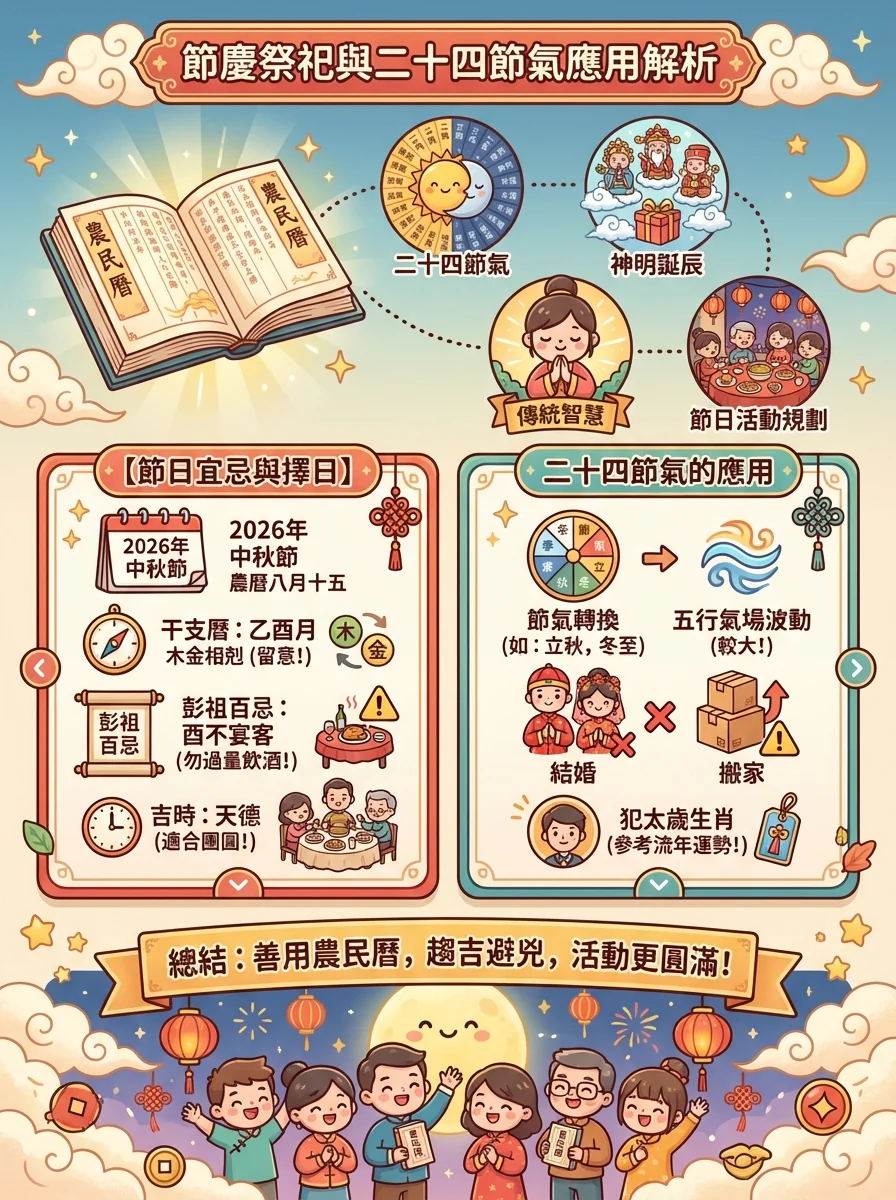
The Chinese Almanac isn't just for date selection; it's also very useful for planning festival activities and worship. By knowing how to combine it with the 24 Solar Terms and deity birthdays, you can make activities more traditional and better at pursuing good fortune and avoiding misfortune.
【Festival Auspicious/Inauspicious Activities and Date Selection】
When choosing a date to plan festival activities, you must pay attention to the "Heavenly Stems and Earthly Branches Calendar" and the "24 Solar Terms". For example, for **2026** Mid-Autumn Festival (15th day of the 8th lunar month), if the day's Heavenly Stems and Earthly Branches are "Yi You Month", with Wood and Metal clashing in the Five Elements, be careful. If Peng Zu's Hundred Taboos coincidentally reminds "You days, do not host banquets", it means don't drink too much alcohol that day, or it's easy to provoke disputes. Even for a family reunion dinner, it's best to hold it during an hour blessed by auspicious deities like "Heavenly Virtue". Also, during solar term transitions (like Beginning of Autumn, Winter Solstice), the Five Elements energy fields fluctuate greatly, so it's generally not recommended to hold major activities like marriage or moving house, especially for zodiac signs in conflict with the Year's Guardian Deity that year; they should refer to annual fortune analysis and not act rashly.
【Worship, Prayers, and Directions】
- Seeking Career & Wealth Luck: To seek wealth, like welcoming the Wealth God on the 5th day of the first lunar month, you need to know how to place offerings facing the year's "Wealth-seeking direction", and avoid directions where malevolent deities like "Five Ghosts" are located.
- Warding Off Evil & Avoiding Misfortune: During the 7th lunar month (Ghost Month), if the energy field near your home is relatively weak (e.g., near a hospital, cemetery), you can check where the "Wenchang" position is in your destiny chart, then place some protective items in that location.
- Seeking Marriage Luck: To find a good partner, before praying to the Matchmaker God on Valentine's Day or other auspicious days, it's best to first analyze your destiny to see if your Ba Zi clashes with peach blossom stars like "Hong Luan", then choose an auspicious day with an even lunar date to pray at a temple, so you can achieve twice the result with half the effort.
【Quick Guide to Deity Birthdays and Worship Strategies】
Deity birthdays are a key part of the Chinese Almanac, a golden opportunity for worship and prayers. For example, on the birthday of Wenchang Dijun (God of Literature, 3rd day of the 2nd lunar month), students and office workers can pray for academic progress and career success; on the birthday of the Matchmaker God (Yue Xia Lao Ren, 15th day of the 8th lunar month), single friends can pray for a good marriage; Wealth God birthdays are further divided into Civil and Military Wealth Gods, business owners can choose which to pray to based on their industry attributes. The hour for worship can refer to Peng Zu's Hundred Taboos and personal destiny. For example, people of a certain zodiac sign can choose an hour that generates or harmonizes with their own Five Elements to pray, doubling the effect, while avoiding the year's inauspicious directions. Another example, on the birthday of an evil-warding deity (5th day of the 5th lunar month), you can time it according to the Heavenly Stems and Earthly Branches calendar, avoiding times that clash with your zodiac sign. Worship isn't just about the day; it should also align with solar term transitions and personal fortune. For instance, after Beginning of Spring, the Five Elements lean towards Wood and Fire, so when worshipping the Military Wealth God, you can increase red offerings to supplement Fire luck; during the Winter Solstice transition, Yin energy is strongest, so when worshipping Wenchang Dijun, you can switch to black offerings to enhance Water energy.
即時四柱五行排盤 + 命格角色卡,由十神實算,配以過萬真實命例大數據交叉分析。
【Analysis of the 24 Solar Terms】
The 24 Solar Terms aren't just related to farming; they are a time system divided according to the sun's movement, greatly influencing date selection, Five Elements balance, and annual fortune. Each solar term has its unique energy field, affecting the distribution of auspicious and inauspicious deities. For example, "Spring Equinox" represents Yin-Yang balance, with Wood energy strongest, very suitable for performing wealth-attracting layouts; "Winter Solstice" has the weakest Yang energy, traditionally a day when many people pray and light lamps to resolve the effects of being in conflict with the Year's Guardian Deity. Each solar term has corresponding daily auspicious/inauspicious activities. For instance, "Qing Ming" (Tomb-Sweeping Day) is not suitable for marriage but is the best time for ancestor worship. These details are crucial for planning major life events. Combining solar terms with the Heavenly Stems and Earthly Branches calendar can also calculate the auspicious/inauspicious periods within Peng Zu's Hundred Taboos. For example, during the "Grain in Ear" period, the Wenchang star is especially strong, perfect for studying for exams; during "Great Heat", the weather is hot and humid, so be careful of malevolent deities appearing.
Personal Fortune Prediction and Feng Shui Layout Guide
Personal Fortune Prediction and Feng Shui Layout Guide
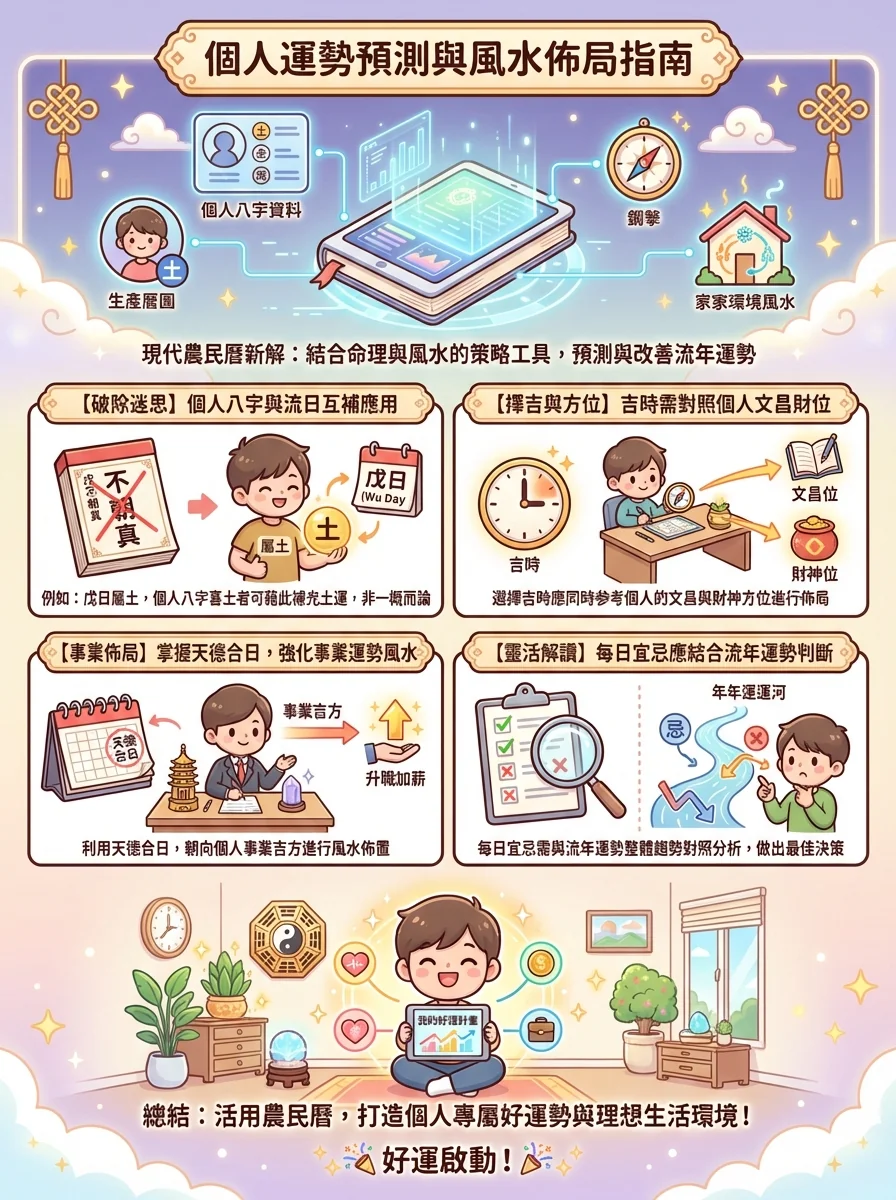
Nowadays, the use of the Chinese Almanac is no longer limited to traditional agricultural guidance; it has evolved into a strategic tool combining personal destiny and environmental Feng Shui, used to predict and improve our annual fortune.
【New Interpretation and Personalized Application of the Almanac】
From a modern perspective, consulting the almanac must involve knowing how to combine it with the data analysis of destiny studies for "personalized" application. For example, Peng Zu's Hundred Taboos says "Wu days, do not worship deities", meaning on lunar Wu days one should not worship. But if your personal Ba Zi belongs to Earth, and Wu days also belong to Earth, you can actually use this day to supplement your Earth luck; you can't apply one rule rigidly. Choosing an auspicious hour is no longer just about whether the hour is auspicious; it also needs to be cross-referenced with your personal Wenchang direction and Wealth God direction. For example, office workers wanting a promotion or raise can note the days each month that are "Heavenly Virtue Harmony" days, then perform Feng Shui layouts facing their career auspicious direction. Daily auspicious/inauspicious activities can also be interpreted in relation to annual fortune. For instance, in **2026**, if a certain zodiac sign encounters a "Five Emptiness" day, theoretically they should avoid investing. But if the Heavenly Stems and Earthly Branches calendar for that day shows auspicious wealth-storing stars like "Golden Cabinet" are present, it might instead be a good opportunity to attract wealth. Nowadays, many almanac query tools indicate which days are suitable for praying and lighting lamps, especially around the Winter Solstice. If you can combine it with your personal wealth-seeking direction for layout, the effect might be even better.
【Annual Fortune Prediction】
To predict your annual fortune, besides referring to the almanac's auspicious hours, malevolent deities, and daily auspicious/inauspicious activities, many professional masters will combine in-depth analysis of your destiny chart and Five Elements. If you know you are "in conflict with the Year's Guardian Deity" that year, you should immediately find ways to resolve it, or seek help from the power of auspicious deities like Wenchang Dijun or the God of Wealth to improve your luck. Analyzing annual fortune isn't just about looking at the Heavenly Stems and Earthly Branches calendar; you also need to consider the impact of the 24 Solar Terms on the individual. To know your career or love fortune for the coming year, the best way is to examine your destiny chart. Through Ba Zi analysis, understand whether your own Five Elements are balanced, then decide what strategy to adopt that year. For example, if you are a Fire-dominant person, developing towards the South that year might be smoother. The auspicious and malevolent deities in the almanac are key to predicting annual fortune. If you encounter the God of Marriage, peach blossom luck might be strong; if you encounter certain malevolent deities, be careful of petty people and disputes. The transition of each solar term affects fortune trends, which is also why many people go to pacify the Year's Guardian Deity and pray/light lamps during Beginning of Spring, hoping to bring a good start to the new year.
【Combining Feng Shui Layout with the Almanac】
Feng Shui layout and the almanac are inseparable, like twins. For major activities like opening a business or moving house, you not only need to choose an auspicious day but also align with Five Elements balance. Nowadays, many destiny analysis tools can help you find the direction most suitable for your destiny, then cross-reference with the almanac's auspicious hours and malevolent deities to act, greatly enhancing Feng Shui effects. For example, if Ba Zi analysis shows you are a Wood-dominant person, you can place green plants in the East (Wood direction) of your home, then choose a day marked "suitable for ground-breaking" on the almanac (of course, avoid days where Peng Zu's Hundred Taboos says "not suitable for construction"), which helps activate Wenchang luck. Remember, annual Feng Shui is more important than rigid traditions. For example, friends in conflict with the Year's Guardian Deity in **2026** should avoid placing red items in the year's Tai Sui direction (e.g., due North), and instead use Five Elements Metal-colored white or gold decorations to resolve negative energy.
【Peng Zu's Hundred Taboos and Color Secrets】
Peng Zu's Hundred Taboos actually hides secrets about color usage, closely related to the generation and restriction cycles of the Five Elements. For example, if the day's Heavenly Stems and Earthly Branches belong to Fire (like Bing Wu day), avoid wearing black clothes (because Water restricts Fire), otherwise it's easy to provoke disputes; conversely, on a Water-dominant day (like Ren Zi day), don't wear red (Fire is restricted by Water), lest it affect wealth luck. If your personal destiny chart shows an imbalance in the Five Elements, then choosing clothing colors by cross-referencing Peng Zu's Hundred Taboos can help resolve the negative impact of being in conflict with the Year's Guardian Deity. Color taboos during solar term periods are even more important. For instance, around Beginning of Spring, Wood energy is newly born, avoid wearing dark blue (belongs to Metal, Metal restricts Wood); during Qing Ming season, avoid bright red, because excessive Fire is feared to restrict weak Metal. In short, the Chinese Almanac is vast and profound; knowing how to use it can really help you pursue good fortune and avoid misfortune. If you want to know more about your **2026 annual fortune**, or want to find a master to match your Ba Zi, why not try Master Xuan Shen's Free Divination Service. Results are available in as fast as 3 hours, and it's completely free. It's free and fast, so there's no harm in trying!
How to use the 2026 Chinese Almanac to choose an auspicious day?
To choose a good day using the 2026 Chinese Almanac, first clearly look at the day's "Auspicious" and "Inauspicious" activities, ensuring your planned activity is within the "Auspicious" range. At the same time, pay attention to whether the day clashes with your own or your family's zodiac sign. By comprehensively considering various deities, malevolent forces, and the Twelve Builders and Breakers (建除十二神) factors, you can choose the most suitable auspicious day to pursue good fortune and avoid misfortune.
What's the difference between a digital almanac and a physical book? How should I choose?
The biggest advantage of a digital almanac is convenience; you can check it anytime on your phone, and many also have personalized fortune analysis and auspicious day reminder features. Physical books offer the traditional feel of flipping through pages, and the content is usually more detailed, suitable for friends who like to study slowly. You can decide based on your usage habits and your needs for additional features.
Is the content of the Chinese Almanac accurate? Is there any scientific basis?
The Chinese Almanac is a crystallization of wisdom based on ancient astronomy, the Heavenly Stems and Earthly Branches calendar, and long-term empirical statistics. It can be considered a form of traditional culture, rather than a precise prediction based on modern empirical science. Many people view it as a reference tool for life planning, used to pursue good fortune, avoid misfortune, and seek spiritual peace.
Why do different versions of the almanac have discrepancies? Which one should I trust?
Different versions of the almanac on the market have slight variations in content because the compilers use different calendar schools, calculation methods, and reference systems for deities and malevolent forces. It is recommended to choose versions published by reputable, long-established compilation institutions, or versions you have used consistently for several years and find relatively accurate.
Could using an electronic almanac APP pose privacy risks? How to protect myself?
Any application that requires input of personal information carries certain privacy risks, and electronic almanac APPs are no exception. When choosing, pay special attention to whether the permissions it requests are reasonable, avoid providing unnecessary sensitive personal information, such as precise location, contact list, etc., to protect your data security.
Besides choosing dates for marriage, what other modern uses does the 2026 Chinese Almanac have?
In 2026, the application of the Chinese Almanac has become very integrated into daily life, no longer limited to major events like weddings and funerals. Many urbanites use it to choose days for meetings, signing contracts, meeting clients, getting haircuts, or even starting a weight loss plan, hoping to add a sense of ritual to everyday matters and make things go more smoothly.
What should I do if I'm in conflict with the Year's Guardian Deity in 2026? Does the almanac provide resolution methods?
According to traditional customs, friends whose zodiac signs are in conflict with the Year's Guardian Deity in 2026 can pay extra attention, but there's no need for excessive panic. The almanac usually provides general resolution suggestions, such as going to a temple to "appease the Year's Guardian Deity", wearing zodiac auspicious ornaments, or maintaining a low profile in daily life and doing more good deeds to seek peace of mind.
How should the "Daily Hourly Fortune" in the almanac be applied to daily life?
The "Daily Hourly Fortune" marks the auspicious/inauspicious activities for the twelve two-hour periods of a day, helping you plan your time more precisely. For example, you can schedule important work during auspicious hours, and handle general chores, like cleaning, during neutral or inauspicious periods, thus pursuing good fortune and avoiding misfortune.