
2026 Heavenly Stems and Earthly Branches Guide | 5 Key Points Beginner's Cheat Sheet, Must-Read for Newcomers!
免費 AI 八字排盤
10 個國際頂尖 AI 模型各自獨立批算再交叉覆核, 並由 1700 年起推演干支,找出與你年、月、日三柱完全相同的歷史真人對照。免費、無需留 Email。
Modern Applications of the Stems and Branches: Fortune-Telling, Feng Shui, and Health Preservation
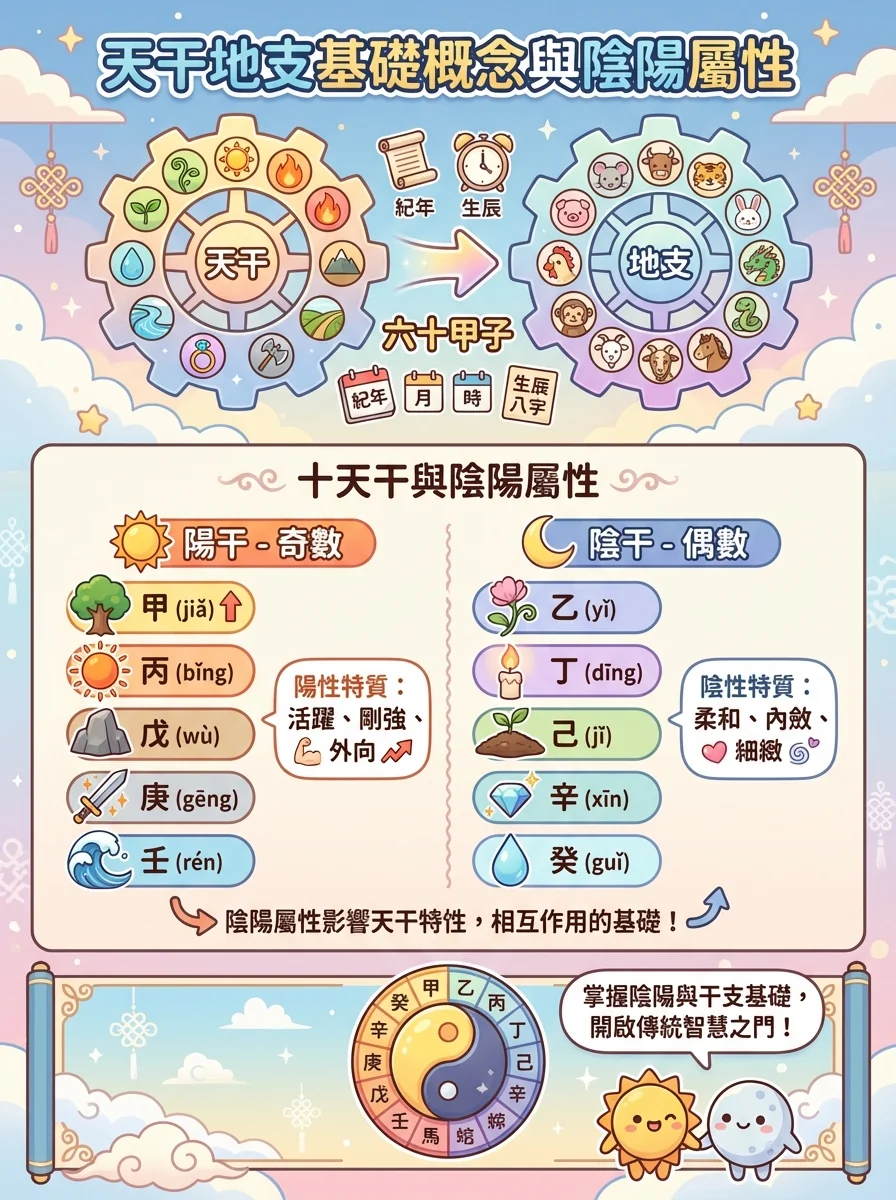
Basic Concepts and Yin-Yang Attributes of Heavenly Stems and Earthly Branches
Hey! Have you heard of "Heavenly Stems and Earthly Branches"? Even if you're not very familiar, you must have seen characters like "Jiazi" or "Bingwu" on Lunar New Year couplets or in horoscopes. Actually, this system, abbreviated as "Ganzhi" (Stems and Branches), is the core of traditional Chinese calendrical and fortune-telling systems. It's like a code that unlocks the mysteries of time and destiny. It consists of ten "Heavenly Stems" and twelve "Earthly Branches." These two sets interlock like gears, one after another, forming sixty combinations, which we call the "Sixty Jiazi Cycle." Since ancient times, this system has been used to calculate years, months, days, and hours, and even for fortune-telling and Bazi (Eight Characters) analysis!
The Ten Heavenly Stems
First, let's talk about the "Heavenly Stems." There are ten in total: Jia, Yi, Bing, Ding, Wu, Ji, Geng, Xin, Ren, Gui. Remember their pronunciations: Jia, Yi, Bing, Ding, Wu, Geng, Xin, Ren, Gui.
The most important thing about these ten brothers is distinguishing their Yin and Yang nature. Odd-numbered ones are Yang, even-numbered ones are Yin. Easy to remember:
與其自己猜,不如讓 10 個 AI 一齊批:
• 今年運勢是好是壞?
• 財運事業運何時到?
• 哪個時期最適合投資?
- Yang Stems: Jia, Bing, Wu, Geng, Ren (Like strong men, very vigorous and active)
- Yin Stems: Yi, Ding, Ji, Xin, Gui (Like gentle women, more introverted and soft)
The Yin-Yang attribute directly influences their character. For example, Jia Wood is like a towering tree, full of vitality and drive; while Yi Wood is like vines and flowers, flexible yet delicate. Another example, Bing Fire (Yang Fire) is like the summer sun, extremely fierce; Ding Fire (Yin Fire) is like candlelight, gentle but warm.
The ancients also had great imagination, connecting the meaning of each Heavenly Stem with nature:
- Jia: Like a seed just breaking through the soil, Yang Qi is wrapped by Yin Qi.
- Yi: Plants in their early growth, with soft, winding branches and leaves.
- Bing: Means "bright," shining upon all things like the sun, full of light.
- Ding: Plants growing robustly, like a person reaching the "strong youth" stage.
- Wu: Means "luxuriant," with vegetation on the earth growing lushly.
- Ji: Means "to rise" or "to record," all things rise up, with form and trace.
- Geng: Means "to change," after the autumn harvest, waiting for spring to come again.
- Xin: Means "new," after fruits ripen, they have a new taste, preparing for a new beginning.
- Ren: Means "pregnant," Yang Qi is hidden underground, all things are like a fetus waiting to be born.
- Gui: Means "to measure," all things are stored away, "measuring" underground when is the right time to sprout.
The Twelve Earthly Branches
After the Heavenly Stems, let's talk about the "Earthly Branches." There are twelve branches, each corresponding to the familiar twelve Chinese zodiac animals: Zi (Rat), Chou (Ox), Yin (Tiger), Mao (Rabbit), Chen (Dragon), Si (Snake), Wu (Horse), Wei (Goat), Shen (Monkey), You (Rooster), Xu (Dog), Hai (Pig).
The Earthly Branches also have Yin and Yang attributes:
- Yang Branches: Zi, Yin, Chen, Wu, Shen, Xu
- Yin Branches: Chou, Mao, Si, Wei, You, Hai
Their corresponding zodiac animals are: Zi-Rat, Chou-Ox, Yin-Tiger, Mao-Rabbit, Chen-Dragon, Si-Snake, Wu-Horse, Wei-Goat, Shen-Monkey, You-Rooster, Xu-Dog, Hai-Pig. Which one are you?
The meanings of the Earthly Branches also originate from the cycles of nature, very poetic:
一個 AI 可能錯,10 個一齊講同一件事呢?
- Zi: "To multiply," Yang Qi begins to stir, all things multiply underground.
- Chou: "To twist," the weather is cold, things contract into a lump.
- Yin: "To evolve," plants in the frozen soil, welcoming spring sunlight, begin to stretch out of the ground.
- Mao: "Luxuriant," the sun shines on the east, all things grow luxuriantly.
- Chen: "To quake" or "to extend," all things quake and grow, Yang Qi has grown past its midpoint.
- Si: "Already," Yang Qi has already spread throughout the earth.
- Wu: "To oppose," all things grow full and plump, Yang Qi is at its peak, Yin Qi begins to appear.
- Wei: "Obscure," the sun passes noon and slants, beginning to become dim.
- Shen: "To extend," the forms of all things are already complete.
- You: "To mature," all things have fully matured.
- Xu: "To extinguish," all things begin to wither and decay.
- Hai: "The core," all things are stored away, becoming solid fruit pits.
Stem-Branch Combinations: The Sixty Jiazi Cycle
So how do the Heavenly Stems and Earthly Branches combine? The rule is simple: "Yang Stems pair with Yang Branches, Yin Stems pair with Yin Branches." Starting from "Jiazi" (Jia is Yang, Zi is Yang), followed by "Yichou" (Yi is Yin, Chou is Yin), and so on, until "Guihai," forming sixty different combinations in total. This sixty-year grand cycle is called the "Sixty Jiazi Cycle." When the Heavenly Stems or Earthly Branches run out, they start over. For example, after the tenth combination "Guiyou," the Heavenly Stem "Gui" is used up, the next Heavenly Stem cycles back to "Jia," and the Earthly Branch is "Xu," so it becomes "Jiaxu." This cycle is endless, forming the basis of our traditional timekeeping system.
Modern Applications of the Stems and Branches: Fortune-Telling, Feng Shui, and Health Preservation
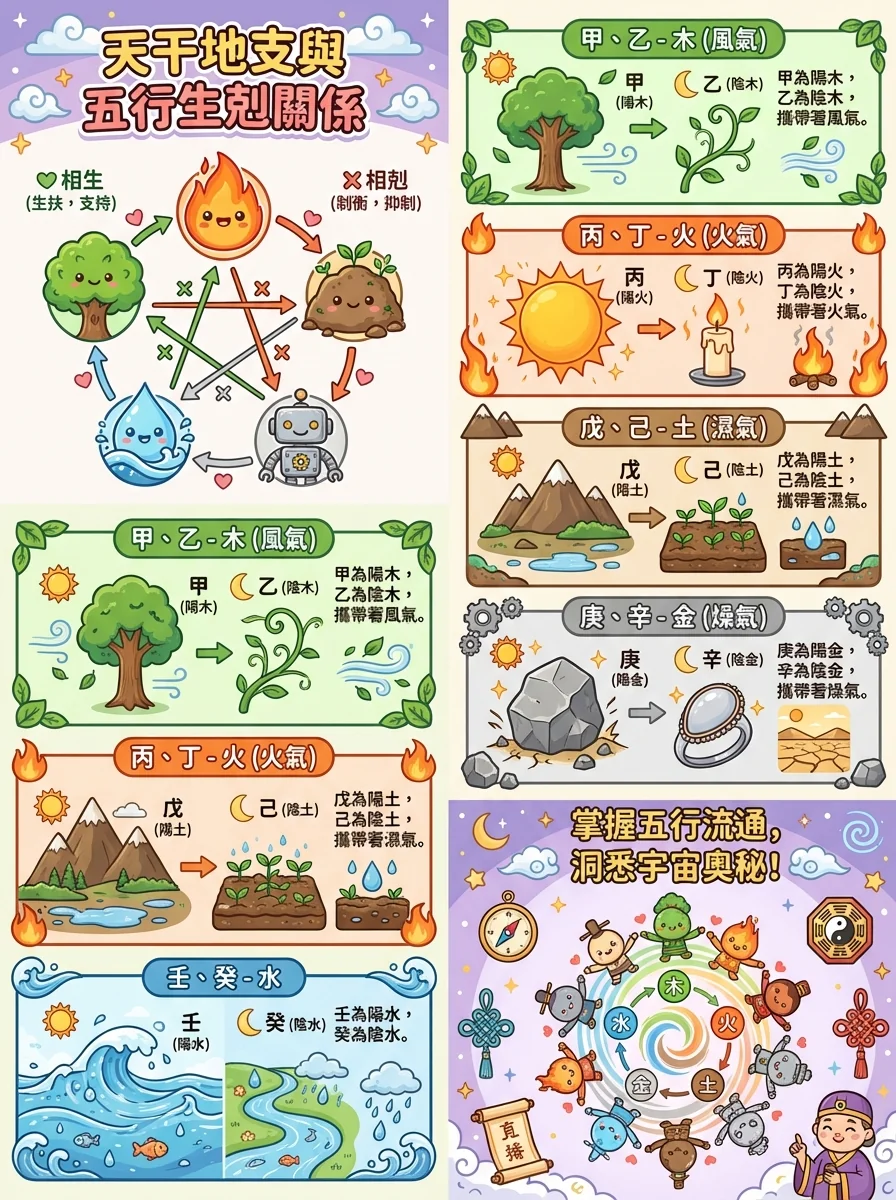
Heavenly Stems, Earthly Branches, and the Five Elements' Generating and Overcoming Relationships
Now that you know the basics of Heavenly Stems and Earthly Branches, the next step is to understand their relationship with the "Five Elements"—Metal, Wood, Water, Fire, and Earth! This relationship is crucial because the "Generating" and "Overcoming" interactions among the Five Elements are key to understanding how the Stems and Branches interact, how fortunes change, and even for Feng Shui and fortune-telling. Each Heavenly Stem and Earthly Branch actually has its own Five Element attribute.
Five Element Attributes of the Heavenly Stems
The ten Heavenly Stems each carry the Qi of a different Five Element, representing the laws of celestial movement:
- Jia, Yi belong to Wood (Jia is Yang Wood, Yi is Yin Wood), representing Wind Qi.
- Bing, Ding belong to Fire (Bing is Yang Fire, Ding is Yin Fire), representing Fire Qi.
- Wu, Ji belong to Earth (Wu is Yang Earth, Ji is Yin Earth), representing Damp Qi.
- Geng, Xin belong to Metal (Geng is Yang Metal, Xin is Yin Metal), representing Dry Qi.
- Ren, Gui belong to Water (Ren is Yang Water, Gui is Yin Water), representing Cold Qi.
Five Element Attributes of the Earthly Branches
The twelve Earthly Branches not only correspond to the twelve zodiac animals but also to the Five Elements, directions, and seasons, representing the changes in Earthly Qi:
- Yin, Mao belong to Wood, representing Spring, direction is East.
- Si, Wu belong to Fire, representing Summer, direction is South.
- Shen, You belong to Metal, representing Autumn, direction is West.
- Hai, Zi belong to Water, representing Winter, direction is North.
- Chen, Xu, Chou, Wei belong to Earth, representing the transitional periods between seasons, direction is Center.
Five Elements Generating and Overcoming Rules
The interactions of the Five Elements are mainly divided into "Generating" and "Overcoming," which together form a dynamic balance system.
- Generating: This means a promoting, nourishing, supporting relationship, like a cycle chain. The rules are:
- Wood generates Fire: Easy to understand, burning wood creates fire.
- Fire generates Earth: Things burn to ash, which returns to earth.
- Earth generates Metal: Metal ores are dug out from the earth.
- Metal generates Water: Metal surfaces condense water droplets with temperature differences (or refers to metal melting into liquid).
- Water generates Wood: Watering plants helps trees grow.
For example, the Earth element "Chen" generates and strengthens the Metal element "Shen," symbolizing that a solid foundation can bring wealth or results.
🕰 由 1700 年起逐日推演干支,找出與你「年、月、日三柱」完全相同的歷史真人。找出我的同盤真人 →
同一個盤,前人走過怎樣的路? - Overcoming: This means a restraining, inhibiting, overcoming relationship, used to maintain balance and prevent any one element from becoming too strong. The rules are:
- Wood overcomes Earth: Tree roots can hold soil, preventing erosion.
- Earth overcomes Water: As the saying goes, "When soldiers come, we send generals; when water comes, we use earth to block it." Earth can build dams to block water.
- Water overcomes Fire: Water can extinguish fire, common sense.
- Fire overcomes Metal: Intense fire can melt metal.
- Metal overcomes Wood: An axe made of metal can chop down trees.
For example, the Metal element "You" overcomes the Wood element "Mao." In fortune-telling, this may represent conflict or challenges, requiring other elements to resolve.
- Clashing: There are "Six Clashes" among the Earthly Branches (e.g., Zi-Wu clash, Mao-You clash), which usually intensify the power of the Overcoming relationship. For example, the clash between "Zi" (Water) and "Wu" (Fire) makes the "Water overcomes Fire" effect more intense and direct. Be especially careful when choosing dates or analyzing Bazi!
Practical Application Example
When analyzing annual fortune trends, the Five Elements' Generating and Overcoming relationships are key. For instance, 2026 is the "Bingwu Year". The Heavenly Stem "Bing" and the Earthly Branch "Wu" both belong to Fire. Wow! The Fire Qi is extremely strong! This "Fire on Fire" combination represents very strong energy but can also be overly dry and hot. If a person's Bazi needs Fire, this year could bring great luck. But if their Bazi dislikes Fire, they need to be cautious about health or emotional issues.
Speaking of which, are you curious to know if your Bazi likes or dislikes Fire? Actually, it's very convenient to find out now. You can try Master Xuanshen's Free Divination Service. You can get results in as fast as 3 hours, and they can also analyze your 2026 annual fortune for you. The best part is it's completely free! Don't miss out! If you know you dislike Fire, you can use the Five Elements principles to balance it, such as increasing the "Earth" element (Fire generates Earth, which can drain Fire Qi) or the "Water" element (Water overcomes Fire, directly suppressing it). For example, place water-related decorations in the North (Water position) of your home to balance the excessive Fire Qi.
Modern Applications of the Stems and Branches: Fortune-Telling, Feng Shui, and Health Preservation
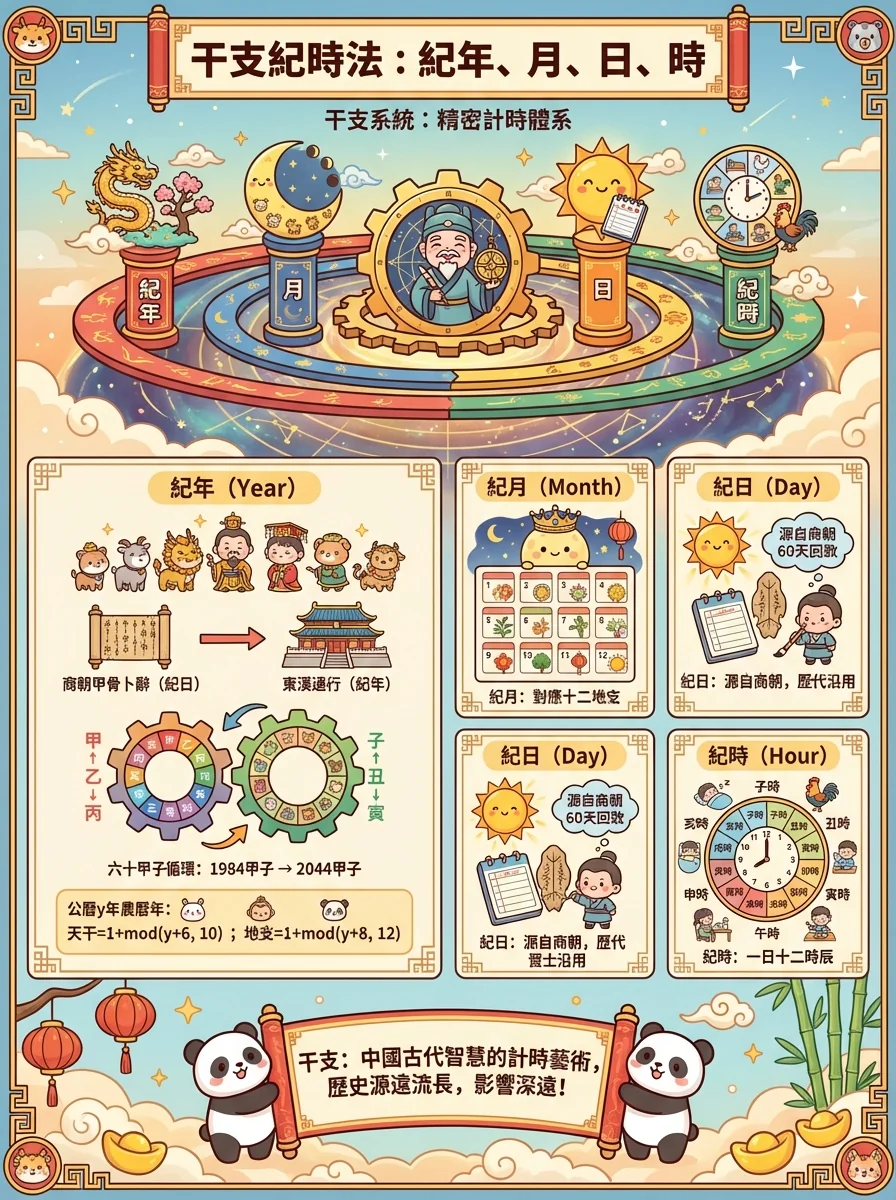
Stem-Branch Timekeeping: Recording Years, Months, Days, and Hours
Do you know how ancient people kept time? Not with watches, but with Heavenly Stems and Earthly Branches! This system is very precise, capable of calculating years, months, days, and even hours, and has a very long history.
Stem-Branch Year Recording
Using Stems and Branches to record years is based on the Sixty Jiazi Cycle. According to archaeological discoveries, oracle bone inscriptions from the Shang Dynasty already used Stems and Branches to record days. Later dynasties continued this practice, gradually developing it to record months, years, and hours. Using Stems and Branches to record years began to take shape around the Western Han Dynasty and became very common by the late Eastern Han Dynasty.
Want to know the lunar year Stem-Branch corresponding to a Gregorian year? There's actually a mathematical formula. We know the most recent Jiazi year was 1984, and the next is 2044. Using the formula, we can calculate the lunar year Stem-Branch for 2026:
- The Heavenly Stem is the 3rd one, which is "Bing."
- The Earthly Branch is the 7th one, which is "Wu."
Therefore, 2026 is the "Bingwu Year"!
Stem-Branch Month Recording
Calculating months is slightly more complex, with two main methods, often used more in divination and Feng Shui.
The first method combines the Heavenly Stems with the "Month Establishment" (Yue Jian). "Month Establishment" refers to the fixed Earthly Branch names for lunar months. Traditionally, the month containing the "Start of Spring" solar term is the first month (Yin Month), followed by the second month (Mao Month), third month (Chen Month), and so on. The month Stem-Branch cycle is sixty months (i.e., five years). Because there's a fixed relationship between the year's Heavenly Stem and the month's Heavenly Stem, there's a mnemonic chant called the "Five Tigers' Month Song" to help remember: "In years of Jia or Ji, Bing starts the beginning; in years of Yi or Geng, Wu is the head..." Memorizing this prevents confusion.
即時四柱五行排盤 + 命格角色卡,由十神實算,配以過萬真實命例大數據交叉分析。
The second method doesn't follow the lunar month but divides months according to the 24 Solar Terms. This is called the "Solar Term Month," a purely solar calendar concept. For example, "Yin Month" starts from "Start of Spring" to the day before "Awakening of Insects," and "Mao Month" starts from "Awakening of Insects" to the day before "Pure Brightness." Using this method, the Gregorian dates for each month are almost the same every year, varying by no more than a day or two, and there's no issue of leap months.
Stem-Branch Day Recording
Using Stems and Branches to record days is a sixty-day cycle. The most impressive thing is that according to historical records, China has continuously used Stems and Branches to record days since at least the Spring and Autumn Period (722 BC), for over 2,700 years without any errors or confusion! Because of its continuity and accuracy, day Stem-Branch has become an important benchmark for historians and astronomers to calculate years.
Stem-Branch Hour Recording
In ancient times, a day was divided into twelve "double-hours," each equal to two modern hours. These twelve double-hours perfectly correspond to the twelve Earthly Branches, so when referring to a double-hour, usually only the Branch is mentioned. For example, Zi Hour is from 11 PM to 1 AM, Chou Hour is from 1 AM to 3 AM, Wu Hour is from 11 AM to 1 PM, and so on. If we further pair the double-hour with a Heavenly Stem, it becomes the "Hour Stem-Branch," which cycles every sixty double-hours (i.e., five days). There's a fixed relationship between the day's Heavenly Stem and each double-hour's Heavenly Stem. For example, on any "Jia" or "Ji" day, its Zi Hour is always "Jiazi Hour."
Modern Applications of the Stems and Branches: Fortune-Telling, Feng Shui, and Health Preservation
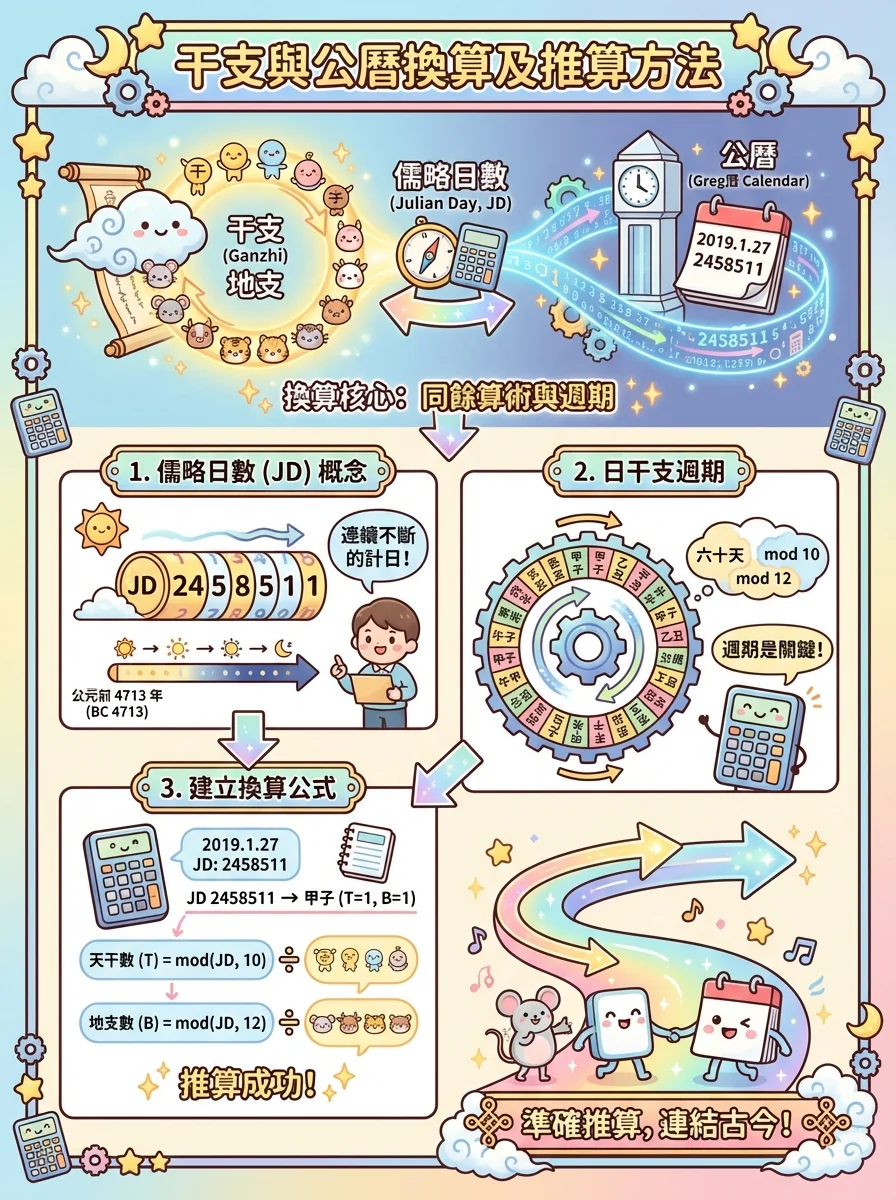
Conversion and Calculation Methods Between Stems-Branches and the Gregorian Calendar
If you're a math enthusiast or very interested in calendars, you'll love this part! To accurately convert between Stems-Branches and the Gregorian calendar, especially for calculating days, you need to use the astronomical "Julian Day Number" (JD) and some mathematical techniques.
Conversion Between Julian Day Number and Day Stem-Branch
The "Julian Day Number" is a continuous count of days starting from January 1, 4713 BC, and is extremely precise. Because the day Stem-Branch cycles every sixty days, as long as we know the Julian Day Number for a particular day and its corresponding Stem-Branch, we can find the conversion formula.
For example, we know that a certain Julian Day Number (JD) is 2458511, and that day is a Jiazi day (Heavenly Stem #1, Earthly Branch #1). Based on this reference point, we can derive the formulas:
- Calculate Heavenly Stem Number (T): The Heavenly Stem cycles every 10 days, so the formula is
T = 1 + mod(JD - 1, 10). If the calculated T is 0, it represents the 10th Heavenly Stem "Gui." Simply put, the T value is usually the last digit of the Julian Day Number plus 1. - Calculate Earthly Branch Number (B): The Earthly Branch cycles every 12 days, so the formula is
B = 1 + mod(JD + 1, 12).
Calculation Example:
Let's try calculating February 17, 2026 (the first day of the first lunar month, Bingwu Year). The Julian Day Number at noon on that day is 2461088.
- Heavenly Stem Number T =
1 + mod(2461088 - 1, 10) = 1 + 7 = 8. The 8th Heavenly Stem is "Xin." - Earthly Branch Number B =
1 + mod(2461088 + 1, 12) = 1 + mod(2461089, 12) = 1 + 9 = 10. The 10th Earthly Branch is "You."
Therefore, the day Stem-Branch for Lunar New Year's Day 2026 is "Xinyou" day.
Feeling a bit dizzy reading this? All this calculation is so complicated! Actually, you don't have to do it yourself. If you want to know the Stem-Branch of your birthday or learn more about your destiny, why not just use Master Xuanshen's Free Divination Service! Just provide your birth date, and they will calculate everything for you, and even analyze your 2026 fortune. Results in as fast as 3 hours, and it's free! How convenient!
Deriving the Sixty Jiazi Sequence Number from Stem-Branch Numbers
Conversely, if you know the Heavenly Stem number T and the Earthly Branch number B, how do you find its position (S) in the Sixty Jiazi table? This requires solving a mathematical equation, but the ancients already devised a "secret trick" formula:
- First calculate
k = 6T - 5B. - If
kis positive, thenS = k. - If
kis negative or zero, thenS = k + 60.
Example:
Find the position of "Renxu" in the Sixty Jiazi cycle. Ren is the 9th Heavenly Stem (T=9), Xu is the 11th Earthly Branch (B=11).
k = 6 * 9 - 5 * 11 = 54 - 55 = -1.- Because
kis negative,S = -1 + 60 = 59.
If you check the Sixty Jiazi table, you'll find "Renxu" is indeed in the 59th position! Actually, these calculation methods are related to the famous ancient Chinese mathematical problem known as the "Problem of Unknown Things," which is celebrated in world mathematics history as the "Chinese Remainder Theorem"!
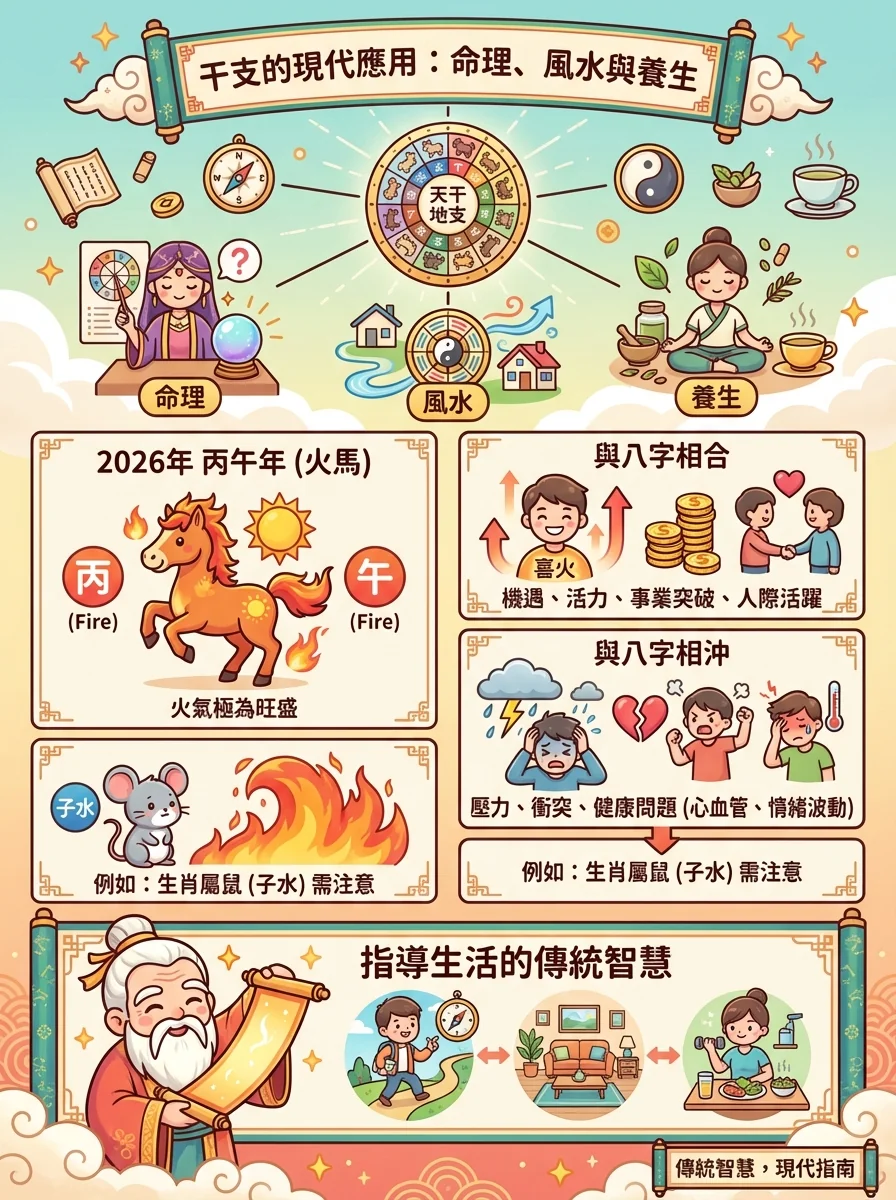
Modern Applications of the Stems and Branches: Fortune-Telling, Feng Shui, and Health Preservation
Modern Applications of the Stems and Branches: Fortune-Telling, Feng Shui, and Health Preservation
After talking so much, what use do Heavenly Stems and Earthly Branches have in our lives today? Although we commonly use the Gregorian calendar, this ancient wisdom of Stems and Branches still plays a very important role in areas like fortune-telling predictions, Feng Shui layout, and Traditional Chinese Medicine health preservation, teaching us how to follow nature and seek good fortune while avoiding harm.
Annual Fortune Predictions
How the fortune of each year unfolds mainly depends on how the year's Stems and Branches interact with the Five Elements of your personal birth Bazi (Eight Characters). 2026 is the Bingwu Year. The Heavenly Stem "Bing" and the Earthly Branch "Wu" both belong to Fire, making it a year of extremely strong Fire Qi. This situation affects people with different destiny charts differently:
- Harmonious with Bazi: If your Bazi likes Fire or needs Fire for balance, then 2026 could very likely be a year full of opportunities, vitality, and development for you. Career may have breakthroughs, and interpersonal relationships may be more active.
- Clashing with Bazi: But if your Bazi dislikes Fire, the excessive Fire Qi may bring stress, conflict, health issues (e.g., cardiovascular, inflammation), or emotional fluctuations. For example, friends born in the Year of the Rat (Zi Water) will experience a "Zi-Wu clash" in 2026, a battle between Water and Fire, leading to greater fluctuations in fortune, requiring caution in all matters.
- Resolution and Harmonization: Don't worry, there are solutions! You can use the Five Elements Generating and Overcoming principles to achieve balance. For example, in a Fire-strong year, you can appropriately increase the "Earth" element (Fire generates Earth, which can drain Fire Qi) or the "Water" element (Water overcomes Fire, directly countering it), such as making adjustments in clothing colors, accessories, or home decor.
Feng Shui Layout Secrets
Feng Shui emphasizes the harmony of time, space, and environmental energy. The annual Stems and Branches are an important basis for adjusting Feng Shui layouts.
- Identify Annual Directions: In the 2026 Bingwu Year, the Fire direction is South. Therefore, the South is the direction with the strongest energy that year. If this position is poorly arranged (e.g., cluttered with junk), it may trigger negative energy. At the same time, the wealth position also changes with the annual cycle. Because Fire generates Earth, the directions belonging to the Earth element (e.g., Southwest, Northeast) can be considered favorable wealth positions in 2026.
- Adjust Home Decor: Based on the needs of your Bazi, you can adjust your home layout. For example, if your Bazi dislikes Fire, you should avoid placing too many red, purple, or glowing items in the South area of your home. Conversely, you can place an aquarium or blue/black decorations in the North (Water position) to use Water to control Fire and achieve balance. To enhance wealth luck, you can place yellow crystals, ceramics, or other Earth-element items in the Southwest or Northeast to receive Fire Qi and generate wealth.
- Resolve Clashes and Sha: If your zodiac animal has a punishing, clashing, harming, or breaking relationship with the annual Earthly Branch, you can make adjustments in the corresponding direction to resolve it. For example, people born in the Year of the Pig (Hai) may have unstable fortune in 2026 (Wu). They can place water-related items in their corresponding Northwest direction (Hai position) to stabilize the Qi field.
TCM Health Preservation by Time
Traditional Chinese Medicine believes that the flow of Qi and blood in our bodies is synchronized with the natural cycles of the Stems and Branches time. The twelve double-hours of the day correspond to the twelve Earthly Branches and also correspond to the rise and fall of the twelve meridians in the human body.
- Time-Based Health Preservation: For example, Zi Hour (11 PM to 1 AM) is when the Gallbladder Meridian is active; one should sleep to help the body detoxify. Wu Hour (11 AM to 1 PM) is when the Heart Meridian is active; it's best to take a short rest and avoid strenuous exercise to prevent excessive Heart Fire.
- Combining with Annual Health Preservation: In the Fire-strong year of 2026 Bingwu, the focus of health preservation is "clearing the heart and reducing fire" and "nourishing Yin and supplementing Water." One should avoid staying up late, eat less spicy and drying foods, and eat more cooling foods like mung beans and winter melon. Because Fire Qi connects to the heart, special attention should be paid to cardiovascular health and emotional management. You can soak your feet in warm water during Hai Hour (9 PM to 11 PM) to guide fire downward, nourish kidney water, and achieve a balanced state of "Water and Fire in Harmony."
New Interpretation of Zodiac Compatibility
Nowadays, looking at zodiac compatibility is no longer just about simple "Three Harmonies and Six Unions" or "Clashes and Punishments." More detailed analysis combines the complete birth Bazi of both parties and the influence of the annual Stems and Branches.
- Five Elements Complementarity: Even if two zodiac animals appear to clash on the surface (e.g., Rat and Horse), if the Five Elements in their Bazi can complement each other—for example, one has strong Water, the other is Dry Earth—the combination of Water and Earth can bring stability, and the relationship can still be harmonious.
- Heavenly Stem Combinations: If the Heavenly Stems of two people can form "Heavenly Stem Five Combinations" (e.g., Jia-Ji combination, Yi-Geng combination, etc.), potential conflicts can be transformed into cooperation or attraction, which is very beneficial for relationship development.
In short, this ancient wisdom of Heavenly Stems and Earthly Branches can be very helpful in our lives if we know how to use it. If you want to know more details, such as your overall fortune for the 2026 Bingwu Year, or how to set up a Feng Shui arrangement to enhance wealth luck, you really shouldn't miss Master Xuanshen's Free Divination Service. They analyze the 2026 annual fortune, with results in as fast as 3 hours, and it's completely free! Go try it now and prepare for the new year!
What are Heavenly Stems and Earthly Branches?
Heavenly Stems and Earthly Branches are an ancient Chinese symbolic system for recording time, used to record years, months, days, and hours. There are ten Heavenly Stems and twelve Earthly Branches. Their combinations form the Sixty Jiazi Cycle, which repeats endlessly. It is a very fundamental and important concept in Chinese culture.
What is the relationship between Heavenly Stems and Earthly Branches?
The relationship between Heavenly Stems and Earthly Branches is like gears, pairing one Yang with another Yang, one Yin with another Yin, matching and combining. The Heavenly Stem leads, followed by the Earthly Branch, starting from "Jiazi" and proceeding in sequence to form a complete cycle. They are not randomly paired.
Why are there 60 combinations of Heavenly Stems and Earthly Branches, not 120?
Although there are 10 Heavenly Stems and 12 Earthly Branches, they are not combined arbitrarily. Because the ancients established the principle of "Yang Stems pair with Yang Branches, Yin Stems pair with Yin Branches," many combinations do not occur, reducing the total number from the mathematical possibility of 120 to 60.
What are the Heavenly Stems and Earthly Branches for 2026? What is their special meaning?
According to the Stem-Branch year recording system, 2026 is the lunar Bingwu Year. The Heavenly Stem is "Bing," belonging to the Fire element; the Earthly Branch is "Wu," corresponding to the Horse zodiac and also belonging to the Fire element. Therefore, 2026 is a year of extremely strong Fire Qi, a "Fire Horse Year," also known as a "Red Horse Year."
How can I calculate the Heavenly Stems and Earthly Branches for a year myself?
Calculating the year's Heavenly Stems and Earthly Branches has fixed formulas, mainly involving simple mathematical operations using the Gregorian year number. The Heavenly Stem is calculated from the last digit of the year, and the Earthly Branch is calculated from the remainder when dividing the year by 12. Once you master the pattern, you can quickly calculate.
In Bazi (Eight Characters) fortune-telling, which pillar is the most important?
Traditionally, many people believe the "Day Pillar" representing oneself is the most important because the Day Pillar's Heavenly Stem (also called the Day Master) represents the core characteristics of the individual. However, modern Bazi analysis emphasizes the overall balance and interaction of the Four Pillars (Year, Month, Day, Hour).
Besides being used for year recording, what other daily applications do Heavenly Stems and Earthly Branches have?
The applications of Heavenly Stems and Earthly Branches are actually very broad and have long been integrated into various aspects of Chinese culture, not just for year recording. It is a foundational symbolic logic used to explain and organize the laws of the universe, nature, and the human body, with an application scope far beyond imagination.
There are many online Heavenly Stems and Earthly Branches calculation tools. How accurate are they?
Calculation tools or mobile apps on the market usually have very high accuracy in "charting" (i.e., generating the Four Pillars of year, month, day, and hour). However, the accuracy of interpreting the destiny chart depends entirely on the underlying analysis logic and the depth of the database.