
The Ultimate 2026 Guide to Qimen Dunjia: Master 7 Layout Techniques Instantly to Predict the Future and Navigate Luck!
免費 AI 八字排盤
10 個國際頂尖 AI 模型各自獨立批算再交叉覆核, 並由 1700 年起推演干支,找出與你年、月、日三柱完全相同的歷史真人對照。免費、無需留 Email。
How to Choose Professional Guidance and Common Questions
Core Principles and Historical Origins
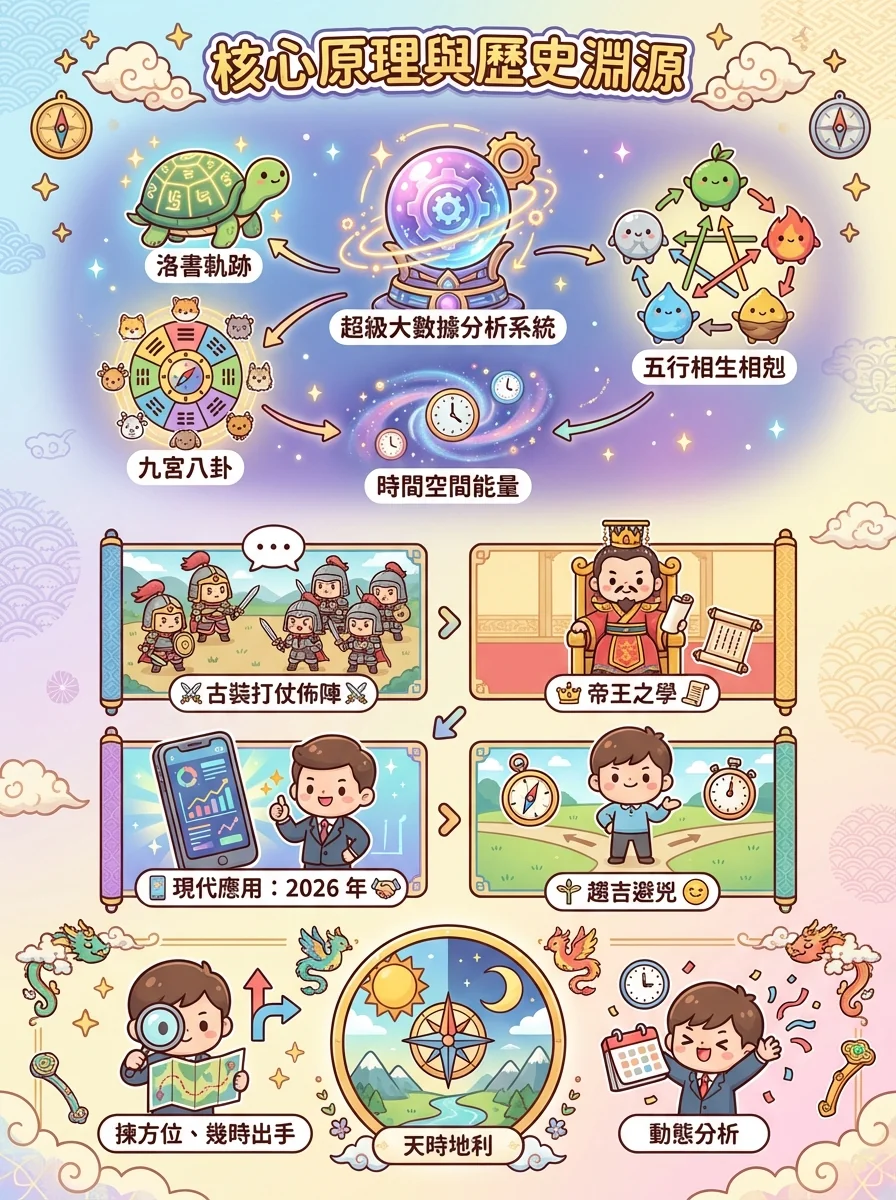
When you hear the term "Qimen Dunjia," do images of ancient military strategists manipulating tortoise shells and arranging Bagua formations from period dramas immediately pop into your head? Many people find it profound and mystical. Indeed, it has been known since ancient times as the "Imperial Art," ranking alongside the other two great secret arts, "Taiyi Shenshu" and "Liuren Shenke," as one of the "Three Styles." Just the name suggests its complexity and mystery. However, in 2026, learning Qimen Dunjia is no longer exclusive to royalty. Simply put, you can think of it as an ancient version of a "super big data analysis system." It uses concepts like the Luo Shu trajectory, Nine Palaces and Eight Trigrams, and the Five Elements' generation and restriction cycles to calculate how energy flows and changes across time and space, helping you make optimal decisions at life's crossroads or in business to attract good fortune and avoid misfortune. It differs from typical fortune-telling focused solely on fate; Qimen Dunjia emphasizes "timing and geographical advantage," serving as a dynamic analytical tool specifically designed to help you choose the right time and direction to act. Primarily used in ancient times for state affairs and military formations, it has been widely applied in the 21st century to business development, market strategy, and even corporate management predictions.
So, what does the name "Qimen Dunjia" actually mean? It is composed of three concepts: "Qi," "Men," and "Dunjia." "Qi" refers to the "Three Qi"—Yi (Sun Qi), Bing (Moon Qi), and Ding (Star Qi)—which you can think of as three powerful trump cards. "Men" refers to the eight gates: Xiu (Rest), Sheng (Life), Shang (Injury), Du (Block), Jing (Brightness), Si (Death), Jing (Alarm), and Kai (Open), representing the auspicious or inauspicious nature of environments in different directions. "Dun" means to hide or conceal, and "Jia" refers to the six Jia stems (Jiazi, Jiaxu, Jiashen, Jiawu, Jiachen, Jiayin). Among the Ten Heavenly Stems, "Jia" is the leader, the most noble, so it doesn't appear openly but usually hides behind the "Six Yi" (Wu, Ji, Geng, Xin, Ren, Gui) as a behind-the-scenes player. In essence, the core of Qimen Dunjia is how to skillfully apply the rules ("Dun") within an extremely complex spatiotemporal environment (composed of the Eight Trigrams, Nine Palaces, and Heavenly Stems and Earthly Branches) to avoid negative influences and draw out the noble energies of the "Jia" leader and the "Three Qi" to find the best path forward ("Men").
與其自己猜,不如讓 10 個 AI 一齊批:
• 今年運勢是好是壞?
• 財運事業運何時到?
• 哪個時期最適合投資?
The origin of Qimen Dunjia is said to be legendary. Legend has it that in ancient times, the Yellow Emperor fought a great battle against Chi You at Zhuolu. Chi You could summon wind and rain and created heavy fog on the battlefield, causing the Yellow Emperor's troops to get lost and putting him at a severe disadvantage. The Yellow Emperor then prayed to heaven, and the goddess Jiutian Xuannü bestowed upon him a celestial book containing the secret arts of Taiyi, Liuren, and Dunjia. Using this book, the Yellow Emperor invented the south-pointing chariot and turned defeat into victory. Later, the Yellow Emperor ordered his strategist Feng Hou to study the celestial book, eventually developing it into the "Three Styles." This art was later passed to Jiang Ziya of the Zhou Dynasty, who condensed it into seventy-two formations. After generations of inheritance, Zhang Liang of the Han Dynasty further refined it into the eighteen Yin-Yang formations we have today. Throughout history, many military strategists and advisors, such as Zhuge Liang and Liu Bowen, were masters of this art. However, when it spread to the common people, it became mythologized, with novels depicting practitioners flying and disappearing into the earth. In reality, it is a profound study reflecting social affairs, life systems, and even astronomy and geography.
How to Choose Professional Guidance and Common Questions
Quick Start Guide to the Qimen Pan Structure
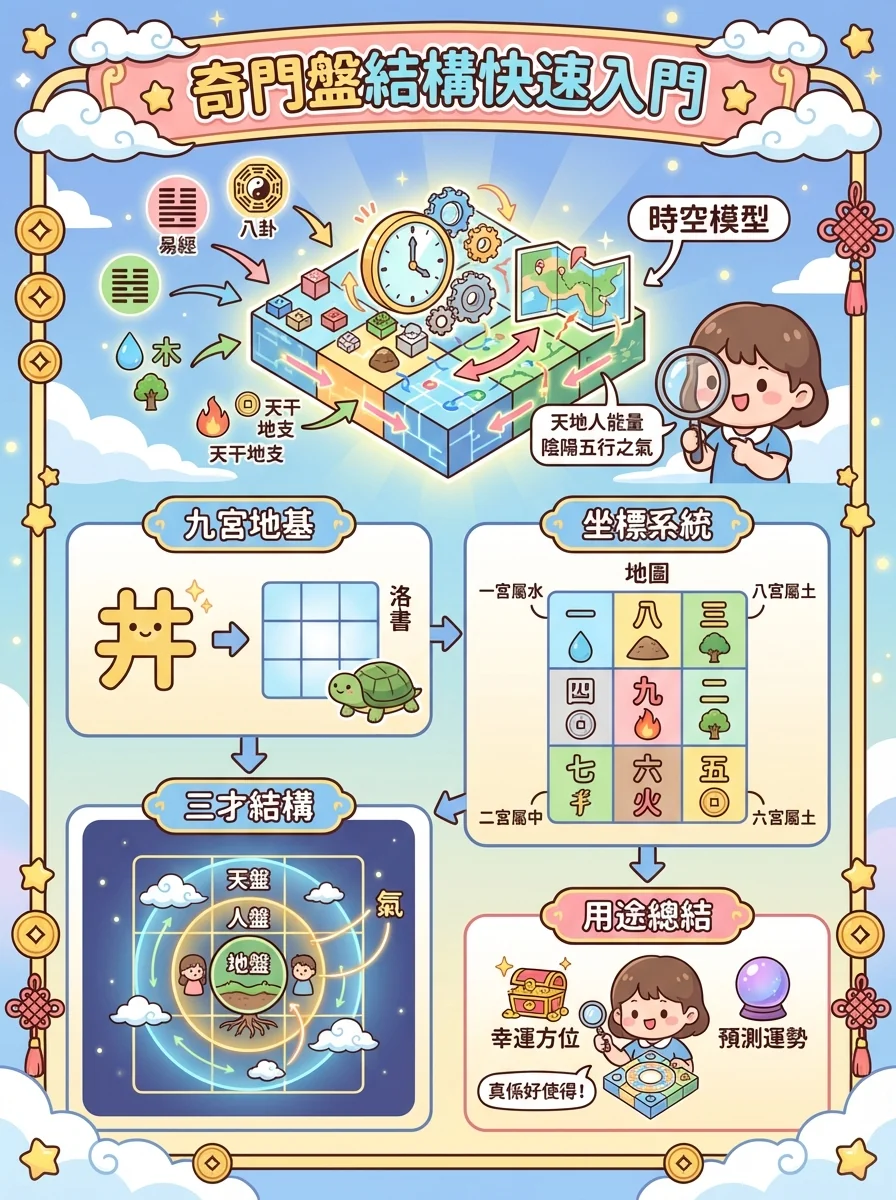
To quickly learn Qimen Dunjia, you must first understand how the "Qimen Pan" (Qimen chart) is constructed. It's like building with Lego, assembling the essence of Chinese metaphysics such as the I Ching, Eight Trigrams, Five Elements, and Heavenly Stems and Earthly Branches. The chart itself is an ultra-precise spatiotemporal model, used in ancient times for warfare and today for predicting fortune and selecting directions—truly versatile. Simply put, think of it as a dynamic GPS map combined with a living clock, displaying the distribution of the energies of heaven, earth, and humanity (i.e., Yin-Yang and Five Elements Qi) at a specific point in time using a set of symbols.
The foundation of a standard time-based Qimen Pan is the "Nine Palaces." This concept originates from the Luo Shu, dividing a square into nine compartments like a tic-tac-toe grid. Each compartment (palace) has its own number and Five Elements attribute (e.g., the first palace belongs to Water, the eighth to Earth), forming the coordinate system of the entire chart. Next, three core categories of symbols are "placed" into these nine compartments: the Eight Gates, Nine Stars, and Eight Deities. This placement process is called "pai pan" (chart arrangement), calculated based on the year, month, day, and hour of your inquiry. Therefore, the chart changes every hour, fully embodying the fluidity of "timing."
First, the "Eight Gates": Kai (Open), Xiu (Rest), Sheng (Life), Shang (Injury), Du (Block), Jing (Brightness), Si (Death), Jing (Alarm). They represent worldly affairs and opportunities and are key to attracting good fortune and avoiding misfortune. For example, if you're asking about wealth, you'd want to find where the "Sheng Men" (Life Gate) falls; that direction is the wealth position at that time. Conversely, if the "Si Men" (Death Gate) presses down on the palace related to your inquiry, it might indicate stagnation or lack of vitality. The rotation of the Eight Gates teaches you how to "borrow luck" by moving to different directions at different times.
Next are the "Nine Stars": Tianpeng, Tianren, Tianchong, Tianfu, Tianqin, Tianxin, Tianzhu, Tianrui, Tianying. They represent celestial energies, both favorable and unfavorable, like a "weather report" for that moment. For instance, Tianfu Star benefits learning, while Tianxin Star suits management. Combining the Nine Stars with the Eight Gates can give you a preliminary judgment of the auspiciousness or inauspiciousness of a matter.
一個 AI 可能錯,10 個一齊講同一件事呢?
The third category is the "Eight Deities": Zhifu, Tengshe, Taiyin, Liuhe, Baihu, Xuanwu, Jiudi, Jintian. They represent mysterious, unseen forces or spiritual-level messages; you can think of them as qualities of an "aura." For example, "Liuhe" represents cooperation and marriage; "Baihu" represents pressure and injury; and "Jintian" is the energy of upward momentum and development.
The most crucial step is placing the symbols representing you and the matter you're inquiring about (usually using the Day Stem, Hour Stem, or specific "Yong Shen") into their corresponding palaces in the chart. Then, you must activate the analysis of the Five Elements' generation and restriction relationships. See whether the relationship between two palaces is generating (friendly) or restricting (conflictual); see if the Five Elements within the palace and those of the Gate, Star, and Deity are harmonious or clashing. This analysis of Five Elements balance is the core skill of chart interpretation. Of course, the chart also includes more advanced symbols like the "Three Qi and Six Yi" (special combinations of Heavenly Stems), "Horse Star," and "Kong Wang" to determine the speed and authenticity of events. But for beginners, remembering the five major components—"Palace, Gate, Star, Deity, Stem"—and how they interact through generation and restriction is the fastest step to learning Qimen Dunjia! If you want to know your own chart but don't want to get a headache arranging it yourself, you can try Master Xuan Shen's Free Divination Service. Results are available in as fast as 3 hours, providing a free analysis of your 2026 annual fortune!
How to Choose Professional Guidance and Common Questions
Modern Applications and Practical Techniques
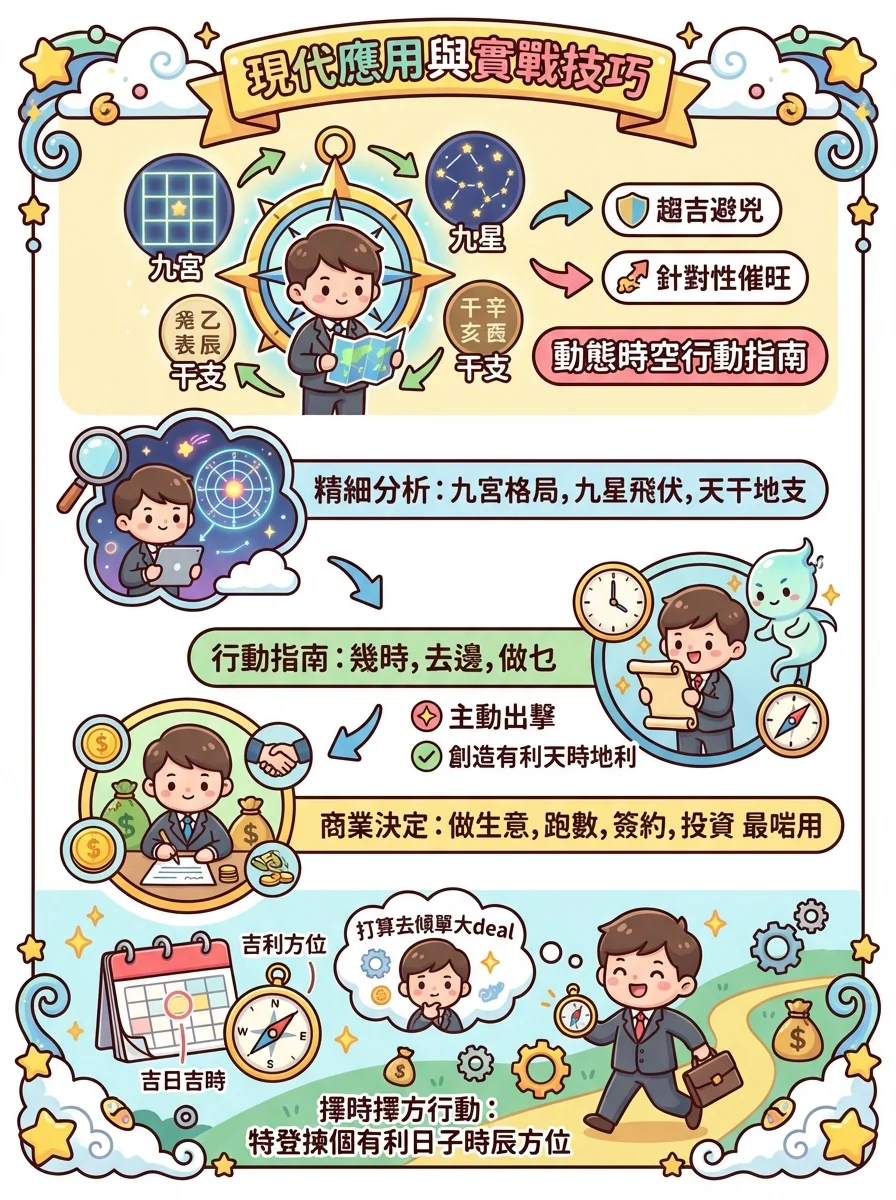
When it comes to enhancing wealth and career luck, Qimen Dunjia, hailed as an advanced metaphysical tool, can be incredibly detailed and dynamic in attracting good fortune and avoiding misfortune, especially for targeted enhancement. It's not just a predictive art but also a guide for proactive action, creating favorable timing and geographical advantages. It helps you analyze the current Nine Palaces pattern, the flight of the Nine Stars, and the combinations of Heavenly Stems and Earthly Branches, then precisely tells you when, in which direction, and what actions to take to best boost your business or job. This spatiotemporal prediction method, combining time and space, is particularly suitable for business decisions like commerce, sales, signing contracts, and investments.
How does it work in practice? It can be approached at several levels. The most direct is "choosing the right time and direction" for action. For example, if you're planning to negotiate a big deal, using Qimen Dunjia's date selection function, you can choose the most auspicious day and hour for you, combined with the day's lucky direction. By deliberately meeting the client at a location in that lucky direction or negotiating business in the company's lucky direction at that time, you place yourself in an energetically favorable "aura," increasing your chances of success. A more professional application involves combining your personal birth chart data to identify your "wealth vault" and "career benefactor" positions based on your fate, then using Qimen to activate them. Regarding Feng Shui layout, Qimen Dunjia can also provide dynamic guidance. Traditional Feng Shui often involves static placements, but Qimen Feng Shui emphasizes "moving with time." For example, if the company's main door happens to be in the "Baihu" (White Tiger) or "Si Men" (Death Gate) position this year, prone to disputes and financial loss, you might not be able to change the door, but you can selectively open windows in different directions within the office based on the daily auspicious Qimen directions, or temporarily relocate your main workstation to the "Sheng Men" (Life Gate) or "Kai Men" (Open Gate) direction inside the room.
同一個盤,前人走過怎樣的路?
Beyond general business applications, here are some specific practical techniques:
-
Hour Chart Application
This is very commonly used for wealth seeking, dating, business negotiations, marriage, exams, travel, starting a new job, construction, moving, competitions, gambling, job interviews, etc. The auspicious directions in Qimen Dunjia are based on the hour you leave home. It's best if the matter can be completed within the same hour. What if your destination isn't in the auspicious direction of the hour chart? You can go to the opposite direction of the auspicious side at least half an hour earlier, pause there, and then proceed to your destination. This technique can also be applied to change personal luck. Doing it the first time you go out in the morning is most effective; try to walk in an auspicious direction to absorb good energy, improving your luck for the whole day.
-
"Sit Alone, Strike the Void" Application
This technique is used in competitive situations like warfare, competitions, meetings, job interviews, negotiations, business deals, soccer, poker, chess, or mahjong. When you can choose your seat, remember "back to the 'Gu' (solitary) direction, face the 'Xu' (void) direction." As ancient texts say: "Sitting with your back to the solitary direction and striking the void, one woman can fight ten men." Doesn't that sound powerful?
-
Three Victorious Grounds Application
This is also used in competitive situations. The first victory: attack the opponent from the palace where Zhifu (the Directing Deity) resides. The second victory: attack from the palace where Jintian (Nine Heavens) Star resides. The third victory: attack from the Sheng Men (Life Gate) towards the Si Men (Death Gate). At the same time, avoid the "Five Non-Attack Directions": the palaces where Zhifu, Zhishi (Directing Messenger), Jintian, Jiudi (Nine Earth), and Sheng Men reside. Attacking these directions might backfire, so be careful.
At this point, you might be wondering about your career and wealth directions for 2026. Want to know more? Why not try Master Xuan Shen's Free Divination Service? Results are available in as fast as 3 hours, providing a free analysis of your 2026 annual fortune to help you find your luckiest direction!
How to Choose Professional Guidance and Common Questions
Self-Study Mindset and Beginner Tips
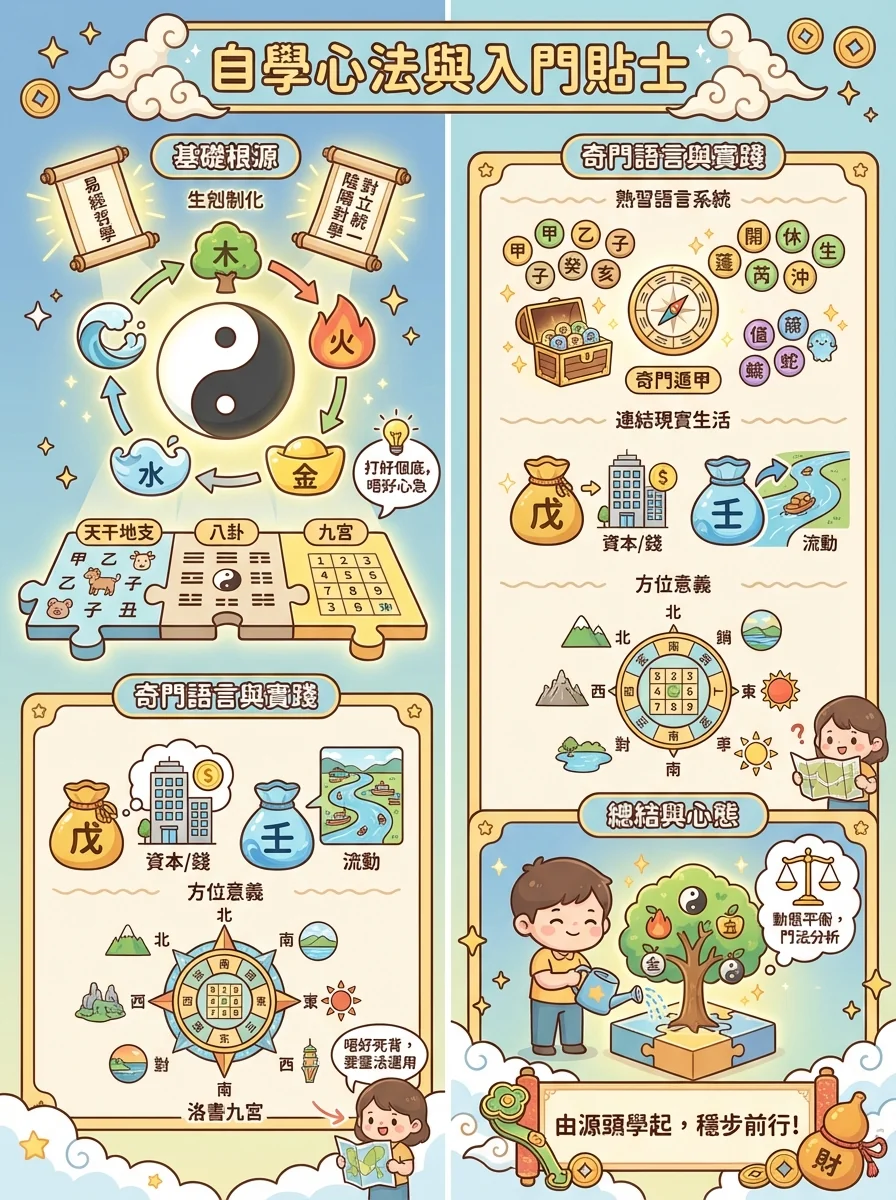
If you're interested in learning Qimen Dunjia on your own, the first step is not to rush into learning how to arrange and interpret charts. When self-studying this ancient predictive art, the most important thing is to start from the source and build a solid foundation, just like learning martial arts requires mastering the horse stance first. The source is the most fundamental concepts: Yin-Yang, Five Elements, Heavenly Stems and Earthly Branches, Eight Trigrams, and Nine Palaces. I recommend starting with the basic philosophical ideas of the I Ching, understanding how "Yin and Yang" are both opposing and unified, then delving into the generation, restriction, overacting, and counteracting relationships of the "Five Elements." Only after grasping this dynamic balance will you be able to analyze how the Five Elements forces interact within a Qimen chart.
After building a foundation, you need to become familiar with Qimen Dunjia's own "language system," including the combinations of Heavenly Stems and Earthly Branches, what the Eight Gates, Nine Stars, and Eight Deities represent (their symbolic meanings), and the directional significance of the Luo Shu Nine Palaces. Don't just memorize by rote; always connect it back to real life. For example, you can combine the imagery of "Wu" Earth (money, capital) with "Ren" Water (flow, risk) to understand investment matters. Or, think about the pioneering, open qualities represented by "Kai Men" (Open Gate) in relation to your recent experiences starting a business or changing jobs. When you turn each symbol into a vivid "story character" with distinct roles, like in a game, you'll see a living "plot" unfold when they interact within the Nine Palaces chart.
即時四柱五行排盤 + 命格角色卡,由十神實算,配以過萬真實命例大數據交叉分析。
Once you have a basic feel for the symbolic system, you can start learning chart arrangement. In 2026, there are many accurate chart arrangement software and apps available, which are very convenient for self-learners. However, I strongly recommend that you arrange a chart by hand at least once. The process of manual arrangement is like a ritual, forcing you to go through all the fundamentals—Heavenly Stems, Earthly Branches, solar terms, Yin-Yang Dun, etc.—from start to finish. This will give you a profound understanding of Qimen Dunjia's spatiotemporal structure. After arranging a chart, don't rush to interpret it. Instead, practice "describing" the chart's situation first: how the Five Elements are distributed, whether the Nine Stars are strong or weak, if the Qi of the Eight Gates flows smoothly, etc. Create an objective "weather report" first, then combine it with specific questions for deduction.
When self-learning reaches the analysis stage, the hardest part is correlating the chart symbols with reality. A very effective method is called "reviewing past charts." That is, create a Qimen chart for yourself or major news events daily. First, record your predictive analysis, then compare it with the actual outcome after the event unfolds. The focus isn't on boasting about accuracy but on finding out "why was my interpretation wrong?" Consistently practicing this review is the fastest way for self-learners to improve. Finally, an important mindset reminder: The ultimate goal of learning Qimen Dunjia shouldn't be merely to satisfy curiosity but to learn how to use its spatiotemporal model to find optimal solutions for your life planning and business decisions, achieving the goal of attracting good fortune and avoiding misfortune. Remember, the "auspicious" and "inauspicious" signs shown in the chart are not absolute but rather indications of energy trends. Learning Qimen Dunjia is about learning how to adjust variables like time, space, people, and events within seemingly unfavorable patterns to guide the energy in a direction beneficial to you.
How to Choose Professional Guidance and Common Questions
How to Choose Professional Guidance and Common Questions
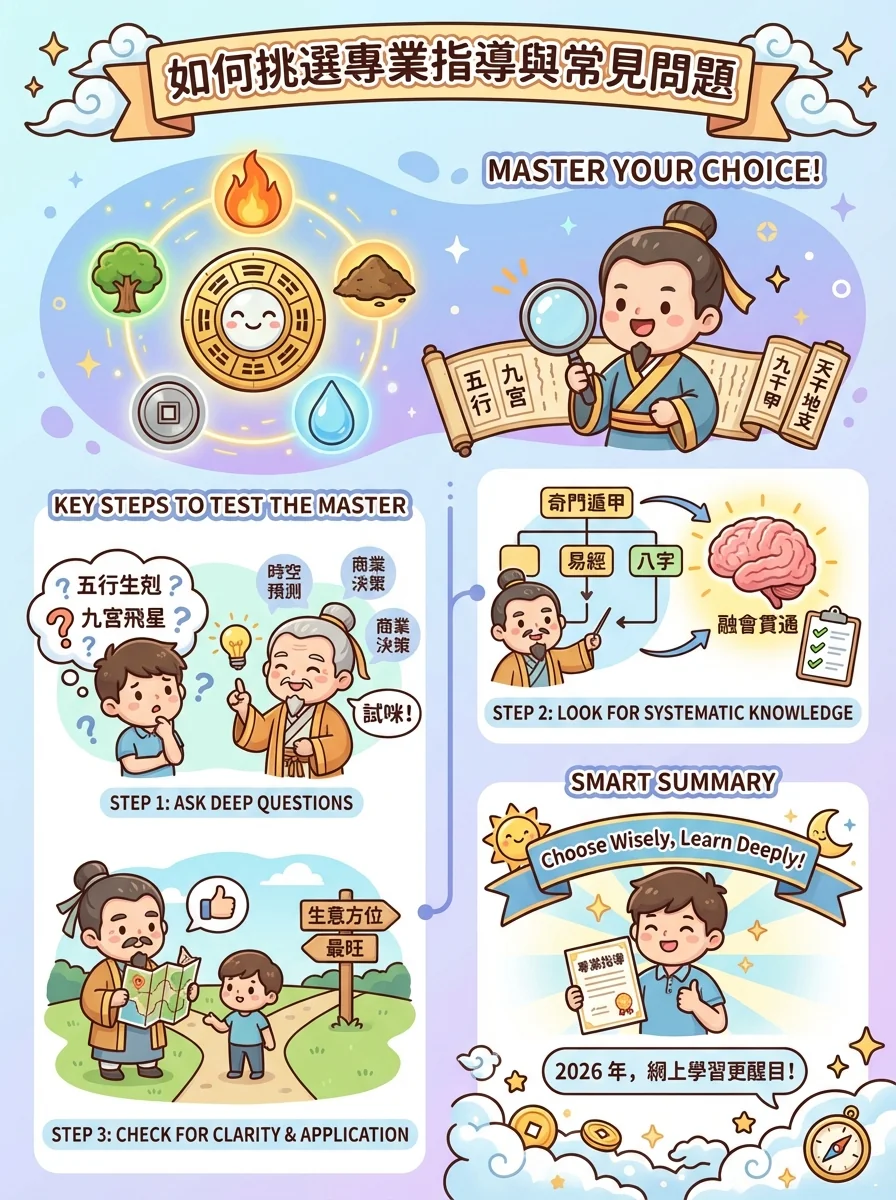
In 2026, there are countless online courses for learning Qimen Dunjia. Finding a truly knowledgeable master or course isn't just about looking at advertisements or reviews. First, you need to know how to ask in-depth questions to "test the waters" and gauge the master's depth. For example, you can ask questions centered around the interaction of the Five Elements' generation and restriction, Nine Palaces flying stars, and Heavenly Stems and Earthly Branches: "Master, I know Qimen Dunjia emphasizes spatiotemporal prediction. If used to determine the development direction for my business, do I need to combine it with my personal birth chart's Five Elements attributes and see where the Nine Stars fly at that time to decide which direction is most auspicious for me?" A knowledgeable master will be happy to explain in detail how to use the balance of Yin-Yang and Five Elements, combined with the layout of the Luo Shu Nine Palaces, to assist your business decisions. Secondly, observe whether the master has systematic knowledge and the ability to integrate concepts. As the foremost of the Three Styles, Qimen Dunjia is closely related to other arts like the I Ching and Bazi. A truly seasoned practitioner won't treat each art in isolation.
When choosing online courses, the most important things are the course's systematic structure and the teacher's practical experience. A deep course should start from the most basic principles of the I Ching and Yin-Yang Five Elements concepts, then gradually delve into chart arrangement methods, the meanings of stars, gates, and deities, and finally teach you how to apply this art to actual divination and direction selection. Another important indicator is whether the course offers interactive sessions and Q&A. Price is a factor, but don't just go for the cheapest option. Instead of buying several cheap but fragmented courses, invest in one that is systematically complete, has a clear teaching path, and offers strong ongoing support. Finally, see if there are free trial sessions or public lectures to personally experience the teaching style and content depth.
What exactly is Qimen Dunjia?
Qimen Dunjia is hailed as the ancient "Imperial Art," a high-level Chinese divination system. It's not just fortune-telling but a spatiotemporal model combining time and space studies, used to analyze environmental energies to make optimal decisions. Primarily used for military strategy in ancient times, it is now widely applied in business strategy and personal development to help people attract good fortune and avoid misfortune.
Is Qimen Dunjia accurate?
The accuracy of Qimen Dunjia largely depends on the interpreter's skill and the inquirer's mindset. It is more like a weather forecast, providing probabilities and possibilities of future trends, not a 100% deterministic fatalism. An experienced master can interpret highly valuable information from the chart symbols to help you see the situation clearly, but the final choice remains in your own hands.
What does the Sheng Men (Life Gate) represent in Qimen Dunjia?
"Sheng Men" is one of the Eight Gates in Qimen Dunjia, often considered one of the most auspicious gates, belonging to the Earth element. It represents vitality, growth, development, and wealth, filled with positive energy. When inquiring about business, investment, real estate, or seeking wealth, if the "Yong Shen" (representing the matter) is associated with Sheng Men and its palace condition is good, it's usually a very positive signal indicating great potential for development.
What are the Eight Gates in Qimen Dunjia?
The "Eight Gates" in Qimen Dunjia refer to eight different energy states simulating human affairs: Kai (Open), Xiu (Rest), Sheng (Life), Shang (Injury), Du (Block), Jing (Brightness), Si (Death), Jing (Alarm). They are distributed across the palaces of eight directions, each with its own unique auspicious/inauspicious attributes and meanings, representing different possibilities for event development. By analyzing the state of the gate's palace, one can judge the auspiciousness or inauspiciousness of human affairs.
Will learning Qimen Dunjia be very difficult in 2026?
Learning Qimen Dunjia indeed requires time and effort, as its system is vast and complex, involving many symbols like Yin-Yang, Five Elements, Heavenly Stems and Earthly Branches, Nine Stars, and Eight Gates. However, with the abundance of online information in 2026, learning resources are much richer compared to the past. With perseverance, the right method, and a good teacher, progressing from shallow to deep, ordinary people can master this art.
Is it accurate to use a mobile app to create a chart? Are there risks?
Professional Qimen Dunjia mobile apps on the market today, as long as the time and calendar settings are correct, usually produce accurate chart arrangements because the arrangement itself is based on fixed mathematical and astronomical rules. The biggest risk isn't in creating the chart but in interpreting it. Without systematic study, interpreting the complex combinations of symbols based solely on literal meanings can easily lead to misjudgments and wrong decisions. Therefore, if you're not dedicated to studying it deeply, relying solely on an app for guesswork, it's better to seek professional help. For example, Master Xuan Shen's Free Divination Service provides results in as fast as 3 hours, helping you analyze your 2026 annual fortune, and it's completely free, so you won't misinterpret the chart and take the wrong path!
What exactly is Qimen Dunjia?
Qimen Dunjia is hailed as the ancient "Imperial Art," a high-level predictive study combining time, space, and mathematics. Initially used primarily for military strategy, by 2026, it has been widely applied in various fields such as business decision-making and personal planning. By analyzing the energy layout of specific times and spaces, it provides guidance for decisions, helping you attract good fortune and avoid misfortune.
How accurate are Qimen Dunjia predictions?
The accuracy of Qimen Dunjia predictions largely depends on the user's skill and interpretive ability. It is not fatalism but a tool for analyzing situations, like a weather forecast, providing a high-probability trend reference. With clear questions and a master's deep expertise, the accuracy can be very high, offering crucial reference for your decisions.
What do the "Eight Gates" in Qimen Dunjia mean? What is the special significance of the Sheng Men (Life Gate)?
The "Eight Gates" are the eight main symbols in the Qimen Dunjia chart representing human affairs: Kai (Open), Xiu (Rest), Sheng (Life), Shang (Injury), Du (Block), Jing (Brightness), Si (Death), Jing (Alarm). Sheng Men is usually considered a highly auspicious gate, representing vitality, wealth, and development. It is particularly suitable for seeking wealth, business negotiations, or starting new projects, making it one of the most desired auspicious symbols when inquiring about matters.
Which divination art is the most accurate? What's the difference between Qimen Dunjia, Bazi, and Zi Wei Dou Shu?
Different divination arts have their own strengths; none is definitively the most accurate. They simply have different approaches and should be chosen based on the problem you want to solve. Qimen Dunjia excels at "divination for specific events," providing immediate strategies for particular issues; whereas Bazi and Zi Wei Dou Shu lean towards analyzing a person's innate destiny and major life trends, falling under the category of "destiny analysis."
In 2026, what modern life scenarios can Qimen Dunjia be applied to?
Entering 2026, the application of Qimen Dunjia has become very practical and is no longer limited to ancient military use. Many people use it for important decisions such as job interviews, business negotiations, investment and financial planning, and even choosing travel times and directions, aiming to go with the flow and increase success chances in all aspects of life.
What kind of people are not suitable for learning or consulting Qimen Dunjia?
Although Qimen Dunjia is a powerful tool, it's not suitable for everyone. People with malicious intent who want to harm others, or those with unstable mental states who are prone to paranoia, should avoid it. An incorrect mindset will not only distort the information in the chart but could also have negative effects on oneself.
Is learning Qimen Dunjia dangerous? Could it affect one's own luck?
Learning and using Qimen Dunjia correctly is not dangerous in itself; it is merely a tool for analyzing spatiotemporal patterns. So-called "dangers" usually stem from an incorrect user mindset or encountering unprofessional masters who provide misleading interpretations. As long as one maintains a righteous mind and a positive attitude towards understanding the analysis results, treating it as an auxiliary tool, it will not affect one's own luck.
I want to find a master for a Qimen Dunjia prediction. How should I choose? What are the approximate costs?
When looking for a master for a Qimen Dunjia prediction, the most important thing is to consider their professional background and reputation, not just price. In 2026, the market rate for a one-time prediction service targeting a specific issue ranges from a few hundred to several thousand Hong Kong dollars, depending on the master's qualifications and the complexity of the question. It's best to inquire first.
What do "Qi," "Men," and "Dunjia" respectively represent in Qimen Dunjia?
The name "Qimen Dunjia" itself contains its core concepts. "Qi" refers to the Three Qi—Yi, Bing, Ding—representing the most energetic elements. "Men" refers to the Eight Gates, representing human affairs. "Dunjia" means hiding the most important leader, "Jia," to protect it from attack, which is the core strategic philosophy of the entire art.