
Yin Yang and the Five Elements | 2026 Ultimate Beginner's Guide: Master the 5 Elements' Mutual Generation and Restraint to Improve Your Health and Fortune
免費 AI 八字排盤
10 個國際頂尖 AI 模型各自獨立批算再交叉覆核, 並由 1700 年起推演干支,找出與你年、月、日三柱完全相同的歷史真人對照。免費、無需留 Email。
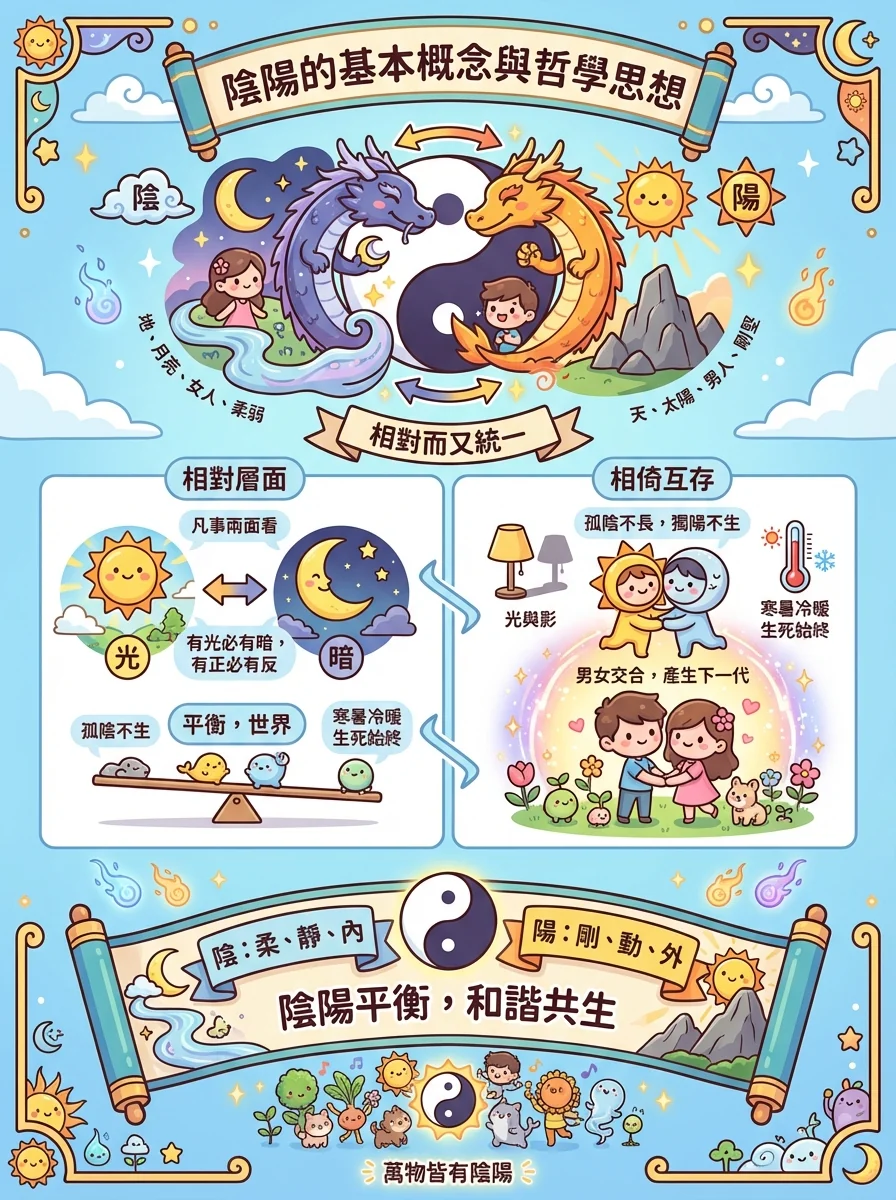
Basic Concepts and Philosophy of Yin-Yang
Yin-Yang is a core concept in ancient Chinese philosophy, used to explain various relative, opposing, and interconnected phenomena in nature and society. It is not simply about good and bad, but describes the dynamic balance of two sides of a whole.
- Yin: Represents passive, still, cold, dark, soft, downward, inward forces. For example: night, female, water, moon.
- Yang: Represents active, moving, warm, bright, strong, upward, outward forces. For example: day, male, fire, sun.
The core idea of Yin-Yang is "solitary Yin cannot generate, solitary Yang cannot grow." The two must depend on and transform into each other to form a complete world. Just like the alternation of day and night and the cycle of seasons, there is no absolute Yin, nor absolute Yang.
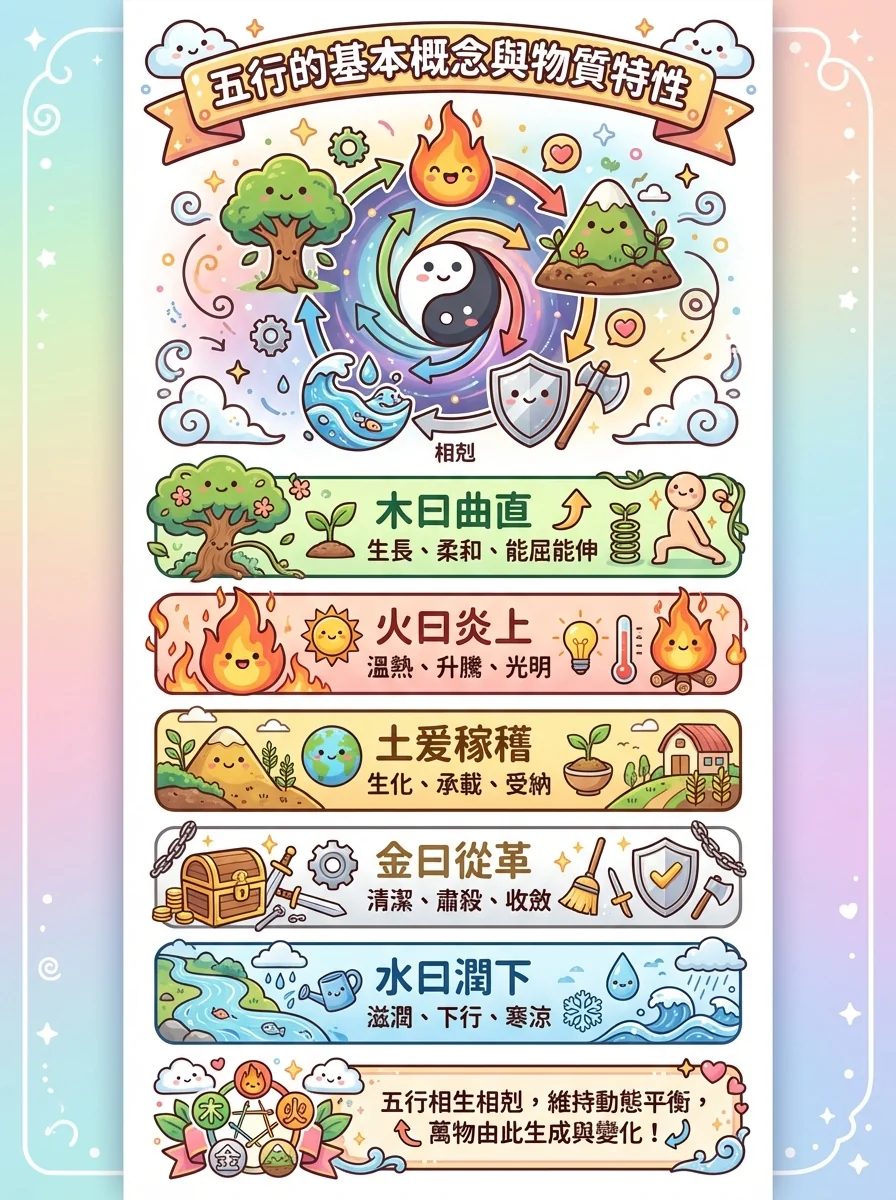
Basic Concepts and Material Characteristics of the Five Elements
The Five Elements, namely Wood, Fire, Earth, Metal, and Water, are the five basic elements or dynamic forces that constitute all things in the universe. They not only refer to specific materials but, more importantly, represent five constantly moving and changing energy forms.
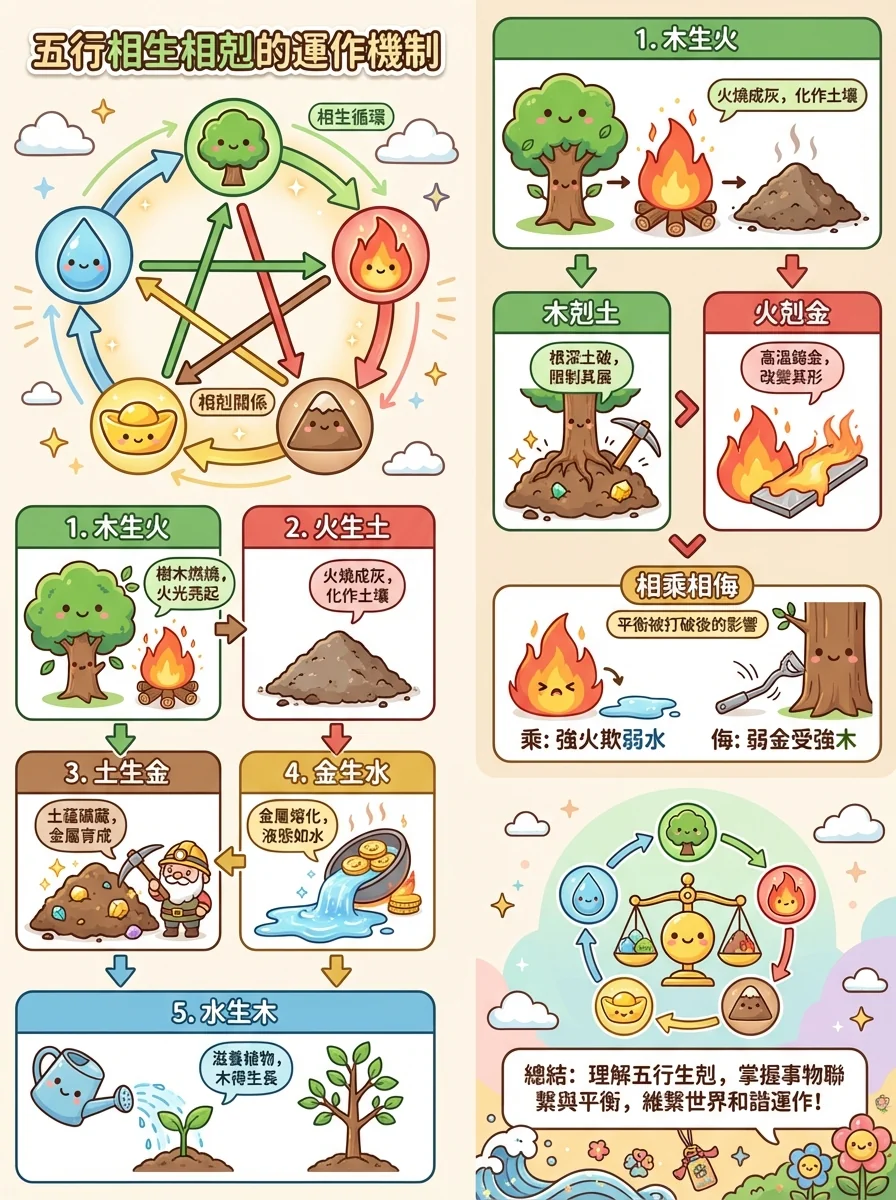
Operational Mechanisms of Generation and Restriction
Among the Five Elements, there exist two fundamental relationships: "Generation" and "Restriction." These two relationships constitute the dynamic balance of the Five Elements system, driving the development and change of all things.
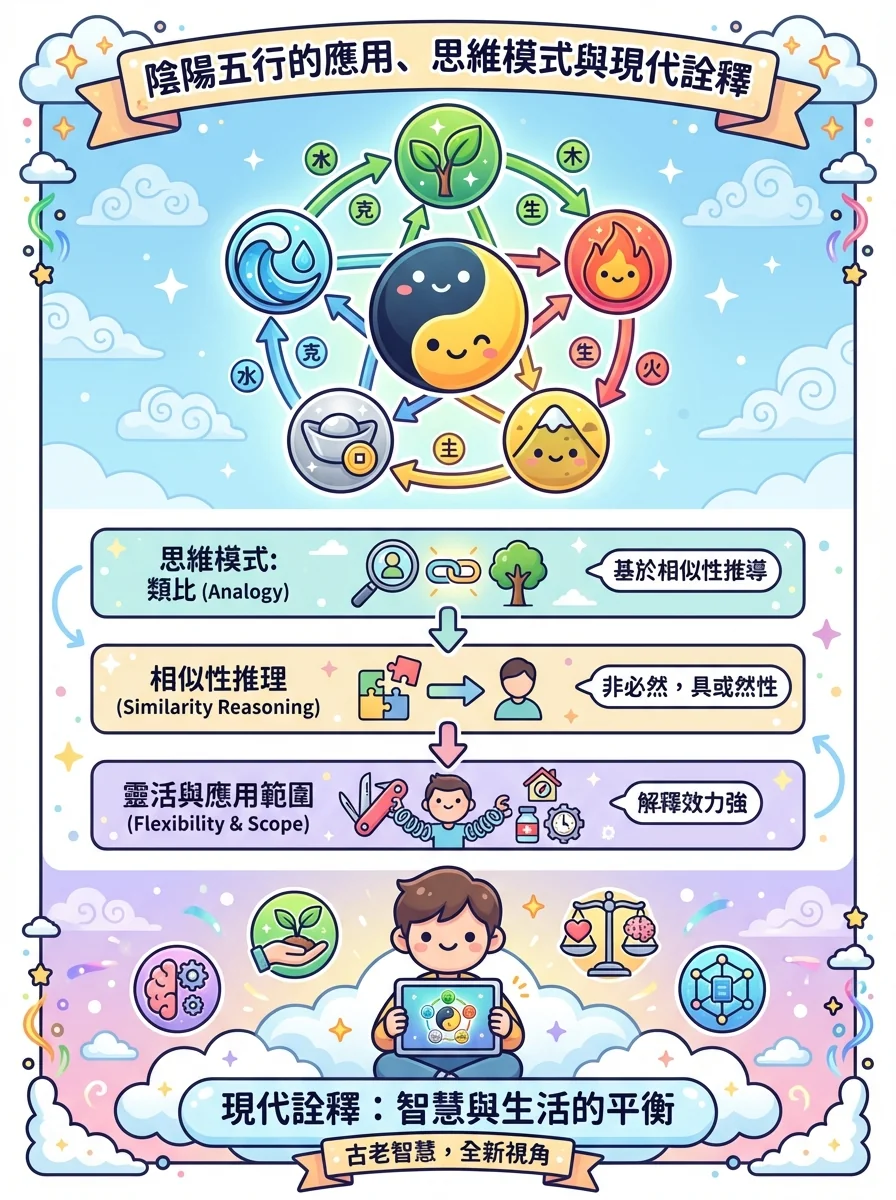
- Generation (Green Outer Circle): Means promotion, nourishment, and assistance. The order is: Wood generates Fire, Fire generates Earth, Earth generates Metal, Metal generates Water, Water generates Wood.
- Restriction (Red Inner Star): Means restriction, control, and inhibition. The order is: Wood restricts Earth, Earth restricts Water, Water restricts Fire, Fire restricts Metal, Metal restricts Wood.
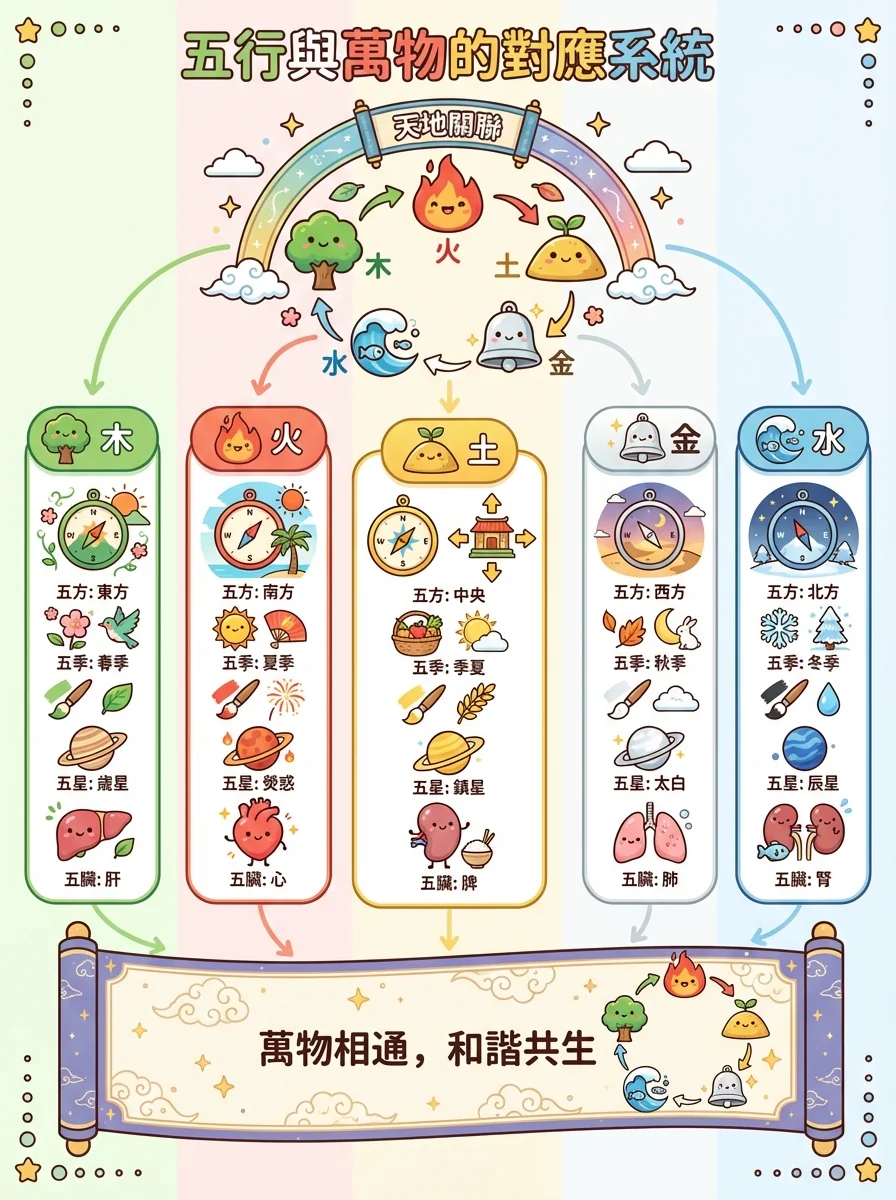
Correspondence System of the Five Elements
The Five Elements theory is a vast correspondence system that incorporates all things in nature, the human body, emotions, seasons, etc., into the Five Elements framework.
East
Spring
Liver
Anger
South
Summer
Heart
Joy
Center
Late Summer
Spleen
Pensiveness
West
Autumn
Lungs
Grief
North
Winter
Kidneys
Fear
Applications, Thought Patterns, and Modern Interpretations of Yin-Yang and the Five Elements
Based on your birth year, you can simply calculate your destiny element. This test can help you preliminarily understand your personality traits and see how your fortune is today based on today's elemental energy.
The Application, Mindset, and Modern Interpretation of Yin Yang and the Five Elements
The Basic Concepts and Philosophical Ideas of Yin and Yang
Hey, when you hear "Yin Yang," do you immediately think of the Taiji diagram with the black and white fish circling each other? Actually, the philosophical ideas behind it are really profound! Simply put, "Yin Yang" is a concept of "opposition yet unity." Why do we say that? Because the ancients observed that many things in this world come in pairs and have two sides. Where there are men, there are women; where there is light, there is shadow; there is a front side and inevitably a back side. To put it plainly, everything has two sides.
In their daily lives, the ancients discovered numerous such relative phenomena, gradually enriching the meaning of Yin and Yang. For example, things belonging to "Yang" are typically: heaven, the sun, men, things that are hard and strong; while things belonging to "Yin" are: earth, the moon, women, things that are soft and gentle.
與其自己猜,不如讓 10 個 AI 一齊批:
• 今年運勢是好是壞?
• 財運事業運何時到?
• 哪個時期最適合投資?
However, just talking about "opposition" doesn't seem to fully explain the relationships between all things. Therefore, "Yin Yang" also includes the meaning of "mutual dependence and indispensability." The saying "孤陰不長,獨陽不生" (solitary Yin cannot grow, solitary Yang cannot be born) means that Yin or Yang alone cannot exist or develop independently. Like light and shadow, without light, how can there be shadow? Similarly, cold and heat, life and death—without one side, the other loses its meaning. The most direct example is that men and women must unite to produce the next generation and continue life. So, Yin and Yang are not only opposites but must also interact and combine to give birth to all things.
The theory of Yin and Yang holds that the world is a material whole. Everything contains the two opposing aspects of Yin and Yang, yet they are also a unified entity. The opposition and unity between Yin and Yang are the fundamental reasons for the occurrence, development, change, and even disappearance of everything in this world. As stated in the ancient text "Su Wen": "陰陽者,天地之道也,萬物之綱紀,變化之父母,生殺之本始" (Yin and Yang are the Way of heaven and earth, the guiding principles of all things, the parents of change, the origin of life and death). This means the law of the contradictory movement of Yin and Yang is an inherent principle of nature; our world itself is the result of the interaction of the two energies, Yin and Yang.
Generally speaking, things that are highly active, outward, ascending, warm, and bright belong to "Yang"; conversely, things that are relatively still, inward, descending, cold, and dark belong to "Yin." Using heaven and earth as a metaphor, the energy of heaven is light and clear, rising upward, so it is Yang; the energy of earth is heavy and turbid, sinking downward, so it is Yin. Using water and fire as examples, water's nature is cold and flows downward, belonging to Yin; fire's nature is hot and burns upward, belonging to Yang. Anything can be classified using Yin and Yang, but the premise is that the two things must be related or be two aspects of the same thing; only then does the classification make sense. If two things are completely unrelated, they cannot be analyzed using Yin and Yang.
Another very important point is that the Yin-Yang attributes of things are not absolute and unchanging, but relative. On one hand, under specific conditions, Yin and Yang can transform into each other; Yin can become Yang, and Yang can become Yin. On the other hand, Yin and Yang can be subdivided infinitely. For example, take a hand: the left hand is Yang, the right hand is Yin; but when you open your palm, the palm facing up is Yang, the back of the hand facing down is Yin. In short, the Five Elements actually evolved from Yin and Yang, and Yin and Yang originated from Taiji; they are fundamentally an inseparable whole.
This all sounds quite mystical, but actually, Yin Yang and the Five Elements are closely related to each person's fortune. If you want to know more about your own destiny and see if you lean more towards Yin or Yang, you might want to try Master Xuanshen's Free Divination Service. It can help you calculate your 2026 annual fortune, with results available in as fast as 3 hours, and it's completely free—really convenient!
一個 AI 可能錯,10 個一齊講同一件事呢?
The Application, Mindset, and Modern Interpretation of Yin Yang and the Five Elements
The Basic Concepts and Material Properties of the Five Elements
After discussing Yin and Yang, let's talk about the inseparable "Five Elements." If Yin and Yang divide the world into two like cutting a cake, then the Five Elements are a more detailed classification system, emphasizing a "concept of balance" where all things in the world "mutually restrain" each other. The Five Elements refer to the movement and transformation of the five most fundamental substances: "Wood, Fire, Earth, Metal, Water."
A long, long time ago, our ancestors, through daily life and production practices, gradually realized that Wood, Fire, Earth, Metal, and Water were essential necessities of life; they couldn't do without them. They extended this concept, believing that all things in the world are produced through the interaction and transformation of these five basic elements. They not only categorized tangible, touchable substances but also incorporated intangible ethical concepts into the Five Elements system.
There exists a very interesting relationship among these five substances: they mutually generate and simultaneously restrain each other. It is through this continuous movement of "mutual generation and restraint" that the world maintains a dynamic balance. This is the most fundamental meaning of the Five Elements theory.
According to the Five Elements theory, each of the five elements has different characteristics:
同一個盤,前人走過怎樣的路?
- "Wood is characterized by bending and straightening" (木曰曲直): This means anything with the characteristics of growth, upward development, and free expansion can be categorized as Wood. Like trees, constantly growing upward, full of vitality, with shapes that are both curved and straight, they are representative of Wood.
- "Fire is characterized by flaming upward" (火曰炎上): This is easy to understand. "Flaming upward" refers to burning and rising. Therefore, anything with a warming, upward-acting nature belongs to Fire.
- "Earth is characterized by sowing and reaping" (土爰稼穡): In ancient times, "sowing and reaping" referred to farming and harvesting. The earth can nurture all things and bear everything, so things with the functions of generation, bearing, and receiving are categorized as Earth.
- "Metal is characterized by change and compliance" (金曰從革): "Change and compliance" carries the meaning of transformation and purification. Therefore, things with the characteristics of cleansing, astringency, and sinking are categorized as Metal.
- "Water is characterized by moistening and descending" (水曰潤下): The innate nature of water is to moisten all things and always flow downward. Therefore, things with the characteristics of coldness, moistening, and downward movement belong to Water.
The ancients used these five characteristics to classify all sorts of things and phenomena in nature, through analogy, into the framework of the Five Elements. For example, the seasons of spring, summer, autumn, and winter are manifestations of the movement of the Five Elements' energies in the heavens, while Earth is said to reside in the transitions between the seasons, acting as a kind of buffering energy. This system made the complex world seem traceable.
The Application, Mindset, and Modern Interpretation of Yin Yang and the Five Elements
The Operating Mechanism of Mutual Generation and Restraint among the Five Elements
The most core and important concept of the Five Elements is the relationship of "mutual generation" and "mutual restraint" among them. Some books also mention "overcoming" and "insulting," which refer to situations where the balance is broken, but today we'll focus on the most basic mutual generation and restraint. These two mechanisms perfectly explain how things are interconnected and how they maintain the great harmony of the world.
First, let's talk about "mutual generation." Mutual generation is like a mother giving birth to a child, who then gives birth to a grandchild, passing down through generations, making the world continuously regenerate and extend. The order of mutual generation among the Five Elements is sequential: Wood generates Fire, Fire generates Earth, Earth generates Metal, Metal generates Water, and finally Water generates Wood again, forming a perfect cycle. To help later generations understand and remember, the ancients came up with a vivid analogy (but remember, this is just an analogy, not actual scientific principle!):
- Wood generates Fire: In ancient times, people drilled wood to make fire, so it's said that Wood can generate Fire.
- Fire generates Earth: Anything burned turns to ashes, returning to the earth and becoming part of the soil.
- Earth generates Metal: Metal ores are hidden beneath soil and rocks, mined from the earth.
- Metal generates Water: Metal melts into liquid under high heat, looking like water; there's also a saying that water droplets condense on metal surfaces in environments with large temperature differences.
- Water generates Wood: This is the easiest to understand; the growth of plants and trees definitely requires water for irrigation.
Where there is generation, there must be "mutual restraint." According to the principle of Yin and Yang, nothing is one-sided. Where there is life, there is death; where there is prosperity, there is restraint; only then can the world develop in balance. Just like in society, where there are bad people, law enforcers appear to maintain order; with law enforcement groups, there are supervisory bodies to check their power. All things in the world operate within this relationship of mutual generation and restraint, checking and balancing each other. If one side becomes too strong or too weak, losing balance, big problems will arise. That's why metaphysical classics often emphasize that the Five Elements must achieve "harmony" and avoid "imbalance."
The order of mutual restraint among the Five Elements skips one element: Wood restrains Earth, Earth restrains Water, Water restrains Fire, Fire restrains Metal, and finally Metal restrains Wood. Similarly, the ancients have analogies to help us remember:
- Wood restrains Earth: Tree roots can penetrate deep into the soil, even breaking through rocks, anchoring the land.
- Earth restrains Water: As the saying goes, "soldiers come to block, water comes with earth to dam." We can use earth to build dams to stop floods.
- Water restrains Fire: A water gun can extinguish a fire; no need for further explanation.
- Fire restrains Metal: Even the hardest metal will melt and be reshaped when exposed to intense flames.
- Metal restrains Wood: An axe or saw made of metal can easily cut down trees.
If you search for Five Elements diagrams online, you'll usually see a pentagram. The clockwise arrows on the outside represent mutual generation, while the intersecting star-shaped arrows inside represent the mutual restraint relationship—it's clear at a glance! Speaking of mutual generation and restraint, these elements actually exist in everyone's Bazi (Eight Characters) destiny chart; some people have strong Wood, others lack Water. Want to know how your Five Elements are distributed and what to pay attention to in 2026? You can try using Master Xuanshen's Free Divination Service. It's completely free, and you can get a real master's reply about your 2026 fortune in as fast as 3 hours, to see if your Five Elements are balanced and if there are any clashing or restraining issues.
即時四柱五行排盤 + 命格角色卡,由十神實算,配以過萬真實命例大數據交叉分析。
The Application, Mindset, and Modern Interpretation of Yin Yang and the Five Elements
The Correspondence System of the Five Elements with All Things
The ancients really loved playing classification and matching games. They placed everything they saw and thought of in life into the vast framework of Yin Yang and the Five Elements, creating an all-encompassing correspondence system. The goal was to use this system to understand the intricate relationships between all things in heaven and earth. This classification system has evolved to this day, with too many correspondences to count. Below are some of the more common Five Elements correspondences; see how many you recognize:
- Five Directions (方位): Wood corresponds to East, Fire to South, Earth to Center, Metal to West, Water to North.
- Five Seasons (季節): Wood is Spring, Fire is Summer, Metal is Autumn, Water is Winter. And Earth? Earth is the period between the transition of each season, called "Late Summer" or "Long Summer."
- Five Colors (顏色): Wood corresponds to Cyan/Green, Fire to Red, Earth to Yellow, Metal to White, Water to Black.
- Five Planets (行星): Wood corresponds to the Year Star (Jupiter), Fire to the Sparkling Deluder (Mars), Earth to the Quelling Star (Saturn), Metal to the Great White (Venus), Water to the Morning Star (Mercury).
- Five Zang Organs (內臟): Wood corresponds to the Liver, Fire to the Heart, Earth to the Spleen, Metal to the Lungs, Water to the Kidneys. This is the foundation of Traditional Chinese Medicine.
- Five Fu Organs (內臟): Wood corresponds to the Gallbladder, Fire to the Small Intestine, Earth to the Stomach, Metal to the Large Intestine, Water to the Bladder. These are paired with the Zang organs.
- Five Constant Virtues (五德): Wood corresponds to Benevolence, Fire to Propriety, Earth to Trustworthiness, Metal to Righteousness, Water to Wisdom.
- Five Flavors (味道): Wood corresponds to Sour, Fire to Bitter, Earth to Sweet, Metal to Pungent (Spicy), Water to Salty.
- Five Notes (聲調): Wood corresponds to the Jue note, Fire to the Zhi note, Earth to the Gong note, Metal to the Shang note, Water to the Yu note. These are the ancient Do Re Mi Fa So.
- Five Mythical Creatures (神獸): Wood corresponds to the Azure Dragon (East), Fire to the Vermilion Bird (South), Earth to the Yellow Qilin/Teng Snake (Center), Metal to the White Tiger (West), Water to the Black Tortoise (North).
- Five Emotions (情緒): Wood corresponds to Anger, Fire to Joy, Earth to Pensiveness/Desire, Metal to Grief, Water to Fear. Uncontrolled emotions can harm the corresponding internal organs!
- Five Sense Organs (感官): Wood corresponds to the Eyes, Fire to the Tongue, Earth to the Mouth/Skin, Metal to the Nose, Water to the Ears.
- Five Senses (感覺): Wood corresponds to Sight, Fire to Taste, Earth to Touch, Metal to Smell, Water to Hearing.
- Five Humors/Body Fluids (體液): Wood corresponds to Tears, Fire to Sweat, Earth to Saliva, Metal to Mucus, Water to Spittle.
- Five Domestic Animals (家畜): Wood corresponds to Dog, Fire to Sheep, Earth to Ox, Metal to Chicken, Water to Pig.
- Five Transformations (生長過程): Wood corresponds to Birth, Fire to Growth, Earth to Transformation, Metal to Harvest, Water to Storage. This is the cycle of "birth in spring, growth in summer, harvest in autumn, storage in winter."
- Five Time Periods (時辰): Wood corresponds to Dawn (sunrise), Fire to Midday, Earth to Afternoon, Metal to Dusk, Water to Midnight.
- Five Fingers (手指): Wood corresponds to the Index Finger, Fire to the Middle Finger, Earth to the Thumb, Metal to the Ring Finger, Water to the Little Finger.
See, from directions and seasons to colors, to the organs and emotions in our bodies, even fingers, can all be classified using the Five Elements—isn't it amazing? The ancient text "Shang Shu" states, "Water moistens and descends, Fire flames upward, Wood bends and straightens, Metal changes and complies, Earth sows and reaps," and then goes on to say, "Moistening and descending produces saltiness, flaming upward produces bitterness, bending and straightening produces sourness, changing and complying produces pungency, sowing and reaping produces sweetness," thus correlating the characteristics of the Five Elements with the five flavors. The spirit of this system is that everything is interconnected and mutually influential.
The Application, Mindset, and Modern Interpretation of Yin Yang and the Five Elements
The Application, Mindset, and Modern Interpretation of Yin Yang and the Five Elements
Now, in 2026, this millennia-old Chinese traditional wisdom of Yin Yang and the Five Elements still influences us in many ways. If we look beyond just the metaphysical perspective, Yin Yang and the Five Elements are actually a very unique "classification method." Yin Yang is a binary division method that "divides the world into two," while the Five Elements go a step further, using five basic attributes to systematically categorize all things in the universe.
As a Way of Thinking
The inherent mindset of Yin Yang and the Five Elements is quite different from the Western science we learn in school. Western science emphasizes "deduction," starting from a major premise and logically deducing conclusions step by step. But Yin Yang and the Five Elements use "analogical reasoning," which is its greatest characteristic. It observes the "similarities" between two things and infers the attributes one should have based on the attributes of the other. For example, we perceive "Water" as having the characteristics of moistening, gentleness, and flowing downward, and then we use "Water" to metaphorically describe the "gentle" aspect of personality; similarly, "Earth" has the characteristics of bearing all things, being stable and honest, so we use it to metaphorically describe the "honest and reliable" aspect of personality. These are extended interpretations made through analogy.
Admittedly, this analogical thinking only has "possibility" and lacks the "necessity" of deductive reasoning, but its advantage is its flexibility and wide applicability in explanation. Moreover, this way of thinking is an excellent catalyst for invention and creativity. The saying "like attracts like, similar energies seek each other" means that similar things resonate with each other due to their likeness. Based on this idea, we can connect different concepts together, generating new ideas. It can be said that this mindset is more conducive to the germination of creativity than rigid deduction.
Application in Traditional Chinese Medicine
When it comes to practical application, Traditional Chinese Medicine (TCM) is the field that uses the theory of Yin Yang and the Five Elements most thoroughly. Ancient medical practitioners, through long-term medical practice, widely applied this theory to explain the origin of human life, the operation of physiological functions, the nature of pathological changes, and used it to guide clinical diagnosis and treatment, making it an indispensable part of TCM theory. Terms you often hear like "Yin-Yang imbalance," "excessive Liver Fire," "Kidney Water deficiency," etc., actually originate from this system.
Application in Metaphysics and Calendars
Of course, when talking about Yin Yang and the Five Elements, we can't leave out the realm of metaphysics and divination. It can be said to be the core theory of all metaphysical arts. Whether it's Feng Shui, destiny analysis, or divination, metaphysicians use the concepts of Yin Yang and the Five Elements to construct a unique cosmic model, then use this framework to explore the operational laws of various things in real life. Among them, the "Heavenly Stems and Earthly Branches" we often talk about have the closest relationship with Yin Yang and the Five Elements. The order of the Heavenly Stems "甲, 乙, 丙, 丁..." perfectly embodies the relationship of the sequential generation of the Five Elements (Wood generates Fire, Fire generates Earth...) and the alternation of Yin and Yang (Yang Wood, Yin Wood, Yang Fire, Yin Fire...). The Earthly Branches "子, 丑, 寅, 卯..." are mainly used to represent the climatic changes of the twelve months, so the ancients placed the concept of "Earth" in the transitions between the seasons. Some theories say the Yin-Yang of the Earthly Branches depends on the Yin-Yang of their "hidden stems," but this view is not entirely accurate. In the structure of the Sexagenary Cycle, it must be Yang Stems paired with Yang Branches, Yin Stems paired with Yin Branches; only then does it conform to the principle of Yin-Yang opposition. The Yin-Yang of the Earthly Branches themselves and the Yin-Yang of their hidden stems are two independent systems and should not be confused.
After reading this, do you feel that Yin Yang and the Five Elements are profound and vast, and want to know how to apply them to yourself? Especially with 2026 approaching, you might want to know your fortune for the coming year to attract good luck and avoid misfortune. Actually, you don't need to search everywhere for a master. There's a very convenient method now: try Master Xuanshen's Free Divination Service. You just need to provide some basic information, and you can get results in as fast as 3 hours. The master will personally calculate your 2026 annual fortune for you, and the key point is it's completely free! If you want to know about your career, wealth, and relationships next year, give it a try soon!
It's already 2026, why do we still need to understand Yin Yang and the Five Elements? Is this theory outdated?
Yin Yang and the Five Elements is a long-standing Eastern philosophical system used to explain the changing patterns of all things in the universe. Even in 2026, it still holds significant reference value. It is not only part of traditional culture but can also be applied to health preservation, interpersonal relationships, career planning, and more, helping us find a method for physical and mental balance in the fast-paced rhythm of modern life. It can be considered a practical life wisdom.
I want to use the Five Elements theory to regulate my body. How should I start? Are there any simple methods?
To use the Five Elements for body regulation, the first step is to roughly understand which elemental attribute your constitution leans towards, and then balance it through diet and lifestyle habits. For example, if your constitution is "Fire"-biased, you might be prone to internal heat and irritability, so you can expose yourself more to "Water"-attribute things for nourishment. These don't require complicated steps; starting from daily small things is enough—it's a simple and effective way of health preservation.
I've heard the Five Elements can help with career development. Is that true? How do I know which industry suits me?
This statement definitely has reference value. The Five Elements theory can analyze a person's innate talents and energy attributes to find more suitable industry directions for personal development. For example, people with a "Wood" attribute have growth and expansive traits, possibly suitable for creative and nurturing work like education or design. Understanding your own Five Elements attributes can help you go with the flow in your career, reduce resistance, and perform better.
Does the Yin Yang and Five Elements theory have any scientific basis, or is it purely superstition?
Yin Yang and the Five Elements is a philosophical model derived from ancient observations of nature, not empirical science in the modern sense, so it's difficult to verify with laboratory data. However, the holistic view, balance view, and cyclical view it embodies share many commonalities with modern fields like systems theory and environmental psychology. It is recommended to view it as a form of Eastern wisdom that offers different perspectives, rather than absolute scientific truth.
I want to consult a master about Five Elements destiny analysis. What are the approximate fees in 2026? Will it be very expensive?
In 2026, the fee range for consulting a master about Five Elements destiny analysis is quite broad, catering to different budgets. The price mainly depends on the master's reputation, experience, depth of service, and time required. A basic personal destiny chart analysis might range from a thousand to several thousand Hong Kong dollars. For more complex services involving Feng Shui, name changes, etc., the fees will naturally be higher.
There are so many masters on the market. How do I choose a trustworthy and professional Five Elements consultant?
When selecting a professional Five Elements consultant, the most important thing is not how strong their marketing is, but their professional background and genuine reputation. A good consultant will patiently listen to your questions and explain the theory in a clear and understandable manner, rather than being mysterious or alarmist. You can start with recommendations from friends or pay attention to user reviews on some professional online forums and communities.
How can I use the Five Elements to arrange my home to enhance fortune? Does it require major renovation?
Using the Five Elements for home arrangement doesn't necessarily require major changes; you can start with simple soft furnishings like colors, materials, and decorations. First, understand the Five Elements attributes of different directions in your home. Then, based on your and your family's needs, strengthen or balance certain energies in appropriate locations. For example, to enhance career luck, you can place metal objects (Metal generates Water) or blue decorations in the North area (belonging to Water), which represents career.
Are there any risks in following Five Elements advice? Could things get worse?
Any theory, if misused or over-interpreted, can have adverse effects. The main risk in following Five Elements advice lies in "obsession" and "blind obedience." If a suggestion causes excessive anxiety or leads to unrealistic major decisions, it might be counterproductive. The healthiest mindset is to treat it as an auxiliary reference to inspire yourself, not as the sole criterion that restricts you.